The British Weekend: When the Weather Joins the Family
TheLifeSpeaks — European Weekend Life Series
While every culture has its own version of the weekend, weekend life in Britain is a fascinating blend of rigid tradition, absolute coziness, and an obsession with the great outdoors—regardless of what the temperamental British weather has to say about it.
It’s a culture where a sudden rainstorm won’t stop a walk in the woods, and where Sunday afternoon has a flavor all its own (literally). Let’s dive into what weekend life in Britain actually looks like, and why their version of slow living is something we should all try.
And for me, this write up has proved a deep walk in to the soul of British culture, seen through its weekends.
Friday Night: The “Swift One” and the Great Escape
The British weekend doesn’t start on Saturday morning; it kicks off precisely at 5:01 PM on Friday.
For city workers, the immediate destination is the local pub. The “Friday night drink” is a foundational pillar of British social life. In London, Manchester, or Edinburgh, you will see crowds of people spilling out onto the pavements, pints in hand, washing away the stress of the working week.
Simultaneously, Friday evening marks the great weekend migration. Britain has a deeply ingrained love for the countryside. Friday trains and motorways are packed with people escaping the concrete sprawl for a weekend in a cozy cottage in the Cotswolds, a hiking trip in the Lake District, or a coastal breath of fresh air in Cornwall.
However for some staying at their place with slowed life and reflective mindset is the real pleasure.
Saturday Morning: A Weekend Begins with Possibilities
The British weekend has one important member of the family who was not invited to the planning meeting: the weather.
It may be sunny when someone opens the curtains and raining by the time the kettle boils. A family may plan a countryside walk, only to find themselves looking for indoor alternatives an hour later. Yet the possibility of changing plans does not necessarily spoil the weekend. It simply becomes part of the experience.
On a Saturday morning, one household may be waking up slowly, while another is already preparing for football practice, shopping, gardening or a visit to friends.
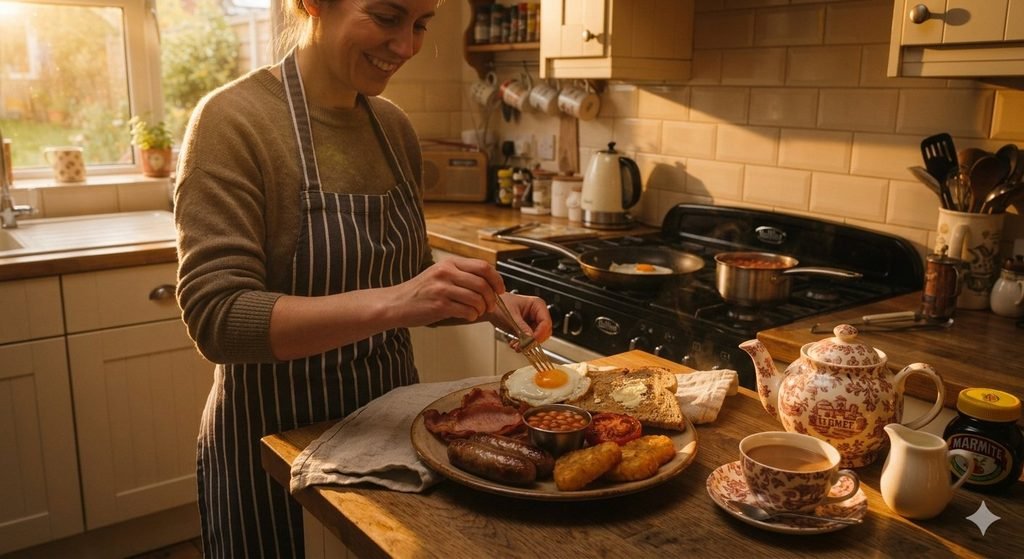
Image credit : Gemini
Perhaps someone is making breakfast. Eggs are being fried, sausages are sizzling in a pan, and mushrooms and tomatoes are warming beside them. Toast appears on the table, along with baked beans and a pot of tea. Some families may enjoy a traditional full English breakfast, while others prefer cereal, porridge, fruit or a quick slice of toast before going out.
Sausages deserve a small place in this morning scene. Made from seasoned meat, traditionally pork in many British varieties, they are familiar companions to eggs, toast and other breakfast favourites. Different recipes use different herbs, spices and seasonings, and regional varieties have their own character. A sausage roll, with seasoned sausage meat wrapped in pastry, may also find its way into a picnic or a quick weekend lunch.
The breakfast table is already telling us something about Britain. Wheat becomes bread and pastry. Eggs come from poultry farming. Milk finds its way into tea and porridge. Meat, vegetables and dairy products connect the kitchen with farms scattered across the countryside.
As an Indian observer, I find this relationship between ordinary food and everyday life particularly interesting. A meal may appear simple, but behind it lies the work of farmers, food processors, bakers, shopkeepers and countless others.
And on a weekend, when there is finally a little more time to enjoy breakfast, nobody needs to rush through the conversation.
The Weekend Wish: Time That Belongs to Us
What does a British person really want from a weekend?
There is no single answer.
A teenager may be looking forward to meeting friends, playing football, listening to music or spending time on a favourite game. A university student may want to sleep late after a demanding week. A working parent may simply wish to enjoy breakfast without checking the clock.
For a young couple, the ideal Saturday might mean a café, a walk through town or a film in the evening. For parents with small children, the same day may revolve around swimming lessons, playgrounds, birthday parties and the familiar business of keeping everyone fed and entertained.
Older people may look forward to gardening, reading, visiting friends, attending a local gathering or enjoying a peaceful afternoon at home. Some may be busy caring for grandchildren; others may value the freedom to follow their own interests.
Of course, these are possibilities, not rules. People of every age have different circumstances, responsibilities and dreams.
Perhaps the common desire is simpler than we imagine: a little more control over one’s time.
The modern weekend has a history of its own. Britain’s industrial society helped establish Saturday and Sunday as a recognisable break from the working week. Saturday half-holidays gradually became more common, while paid holidays expanded during the twentieth century. The weekend that many people now take for granted was shaped by changes in work, social life and the struggle for leisure time.
Today, not everyone enjoys the same Saturday and Sunday. Healthcare workers, shop assistants, transport staff, hospitality workers and many others may work while their friends and families are free. For them, the weekend can fall on a different day.
Still, the wish for rest, recreation and companionship remains familiar across occupations and generations.
A Garden, a Walk and the Unpredictable Sky
If the weather cooperates, the garden may become the first destination of the day.
Someone is trimming a hedge. Someone else is removing weeds from a flowerbed. A child is inspecting a worm after the rain, while an older family member explains why a particular plant grows better in one corner of the garden than another.
Gardening can be work, but it is also a form of relaxation. It offers a reason to step outdoors, notice the changing seasons and watch something grow slowly.
The British garden may contain roses, lavender, daffodils, tulips, herbs or vegetables. Some are carefully planned; others are informal spaces where flowers and plants are allowed to grow more freely.
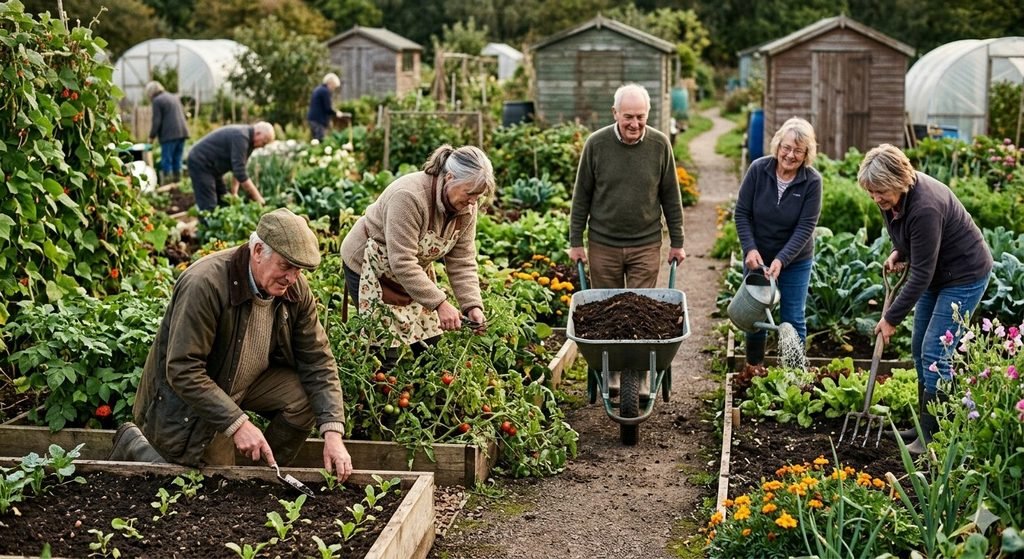
Image credit : Gemini
A small urban garden, a shared allotment and a large country garden may look very different, yet all can provide a connection with nature. An allotment is a collection of small plots, usually rented individually, where people grow vegetables, fruit, herbs or flowers. Someone may come to tend potatoes while a neighbour waters beans or picks strawberries. They work on their own little piece of land, but conversations naturally cross the boundaries. Gardening tips, spare seedlings, surplus vegetables and stories about old family recipes may pass from one plot to another. For older people especially, an allotment can be more than a place to grow food—it can be a place to keep active, meet people and pass practical knowledge to another generation.
For some older people, a gardening club is much more than a place to grow flowers and vegetables. It can become a small weekly community of its own.
One person may be planting potatoes, another tending flowers, while someone else repairs a greenhouse or simply sits nearby enjoying a cup of tea and conversation. Experienced gardeners share their knowledge, younger members may learn from them, and the harvest sometimes finds its way home with the people who helped grow it.
For those who no longer have a garden of their own, a shared allotment can offer something precious: a reason to step outdoors, meet familiar faces, keep gently active and feel that they are still contributing to something that will grow.
And then emerges the familiar desire: shall we go for a walk?
A village lane, a public footpath, a woodland trail or a route beside a river may offer an easy escape from the demands of the week. In the countryside, walkers encounter hedgerows, old stone walls, grazing sheep, farmhouses and fields stretching towards the horizon.
The landscape is not merely a beautiful background. It is part of the country’s working life.
Britain’s agricultural landscape is strongly shaped by grassland and livestock farming. This helps explain why grazing sheep and cattle, open pastures and fields are such familiar features of many British rural scenes.
A child watching sheep in a field may be enjoying a simple outing. An older family member might remember when farming involved different machinery, fewer digital tools and more labour-intensive routines. A conversation about the animals can lead naturally to a conversation about how rural life has changed.
And if rain arrives halfway through the walk, there is always the possibility of heading towards the nearest café.
The British weather has once again joined the family.
The High Street, the Market and a Cup of Tea
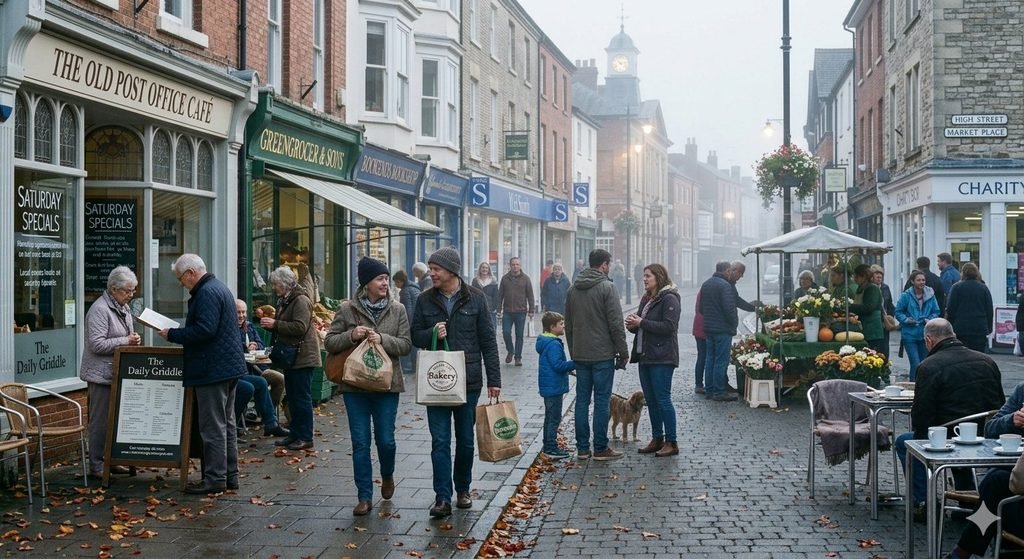
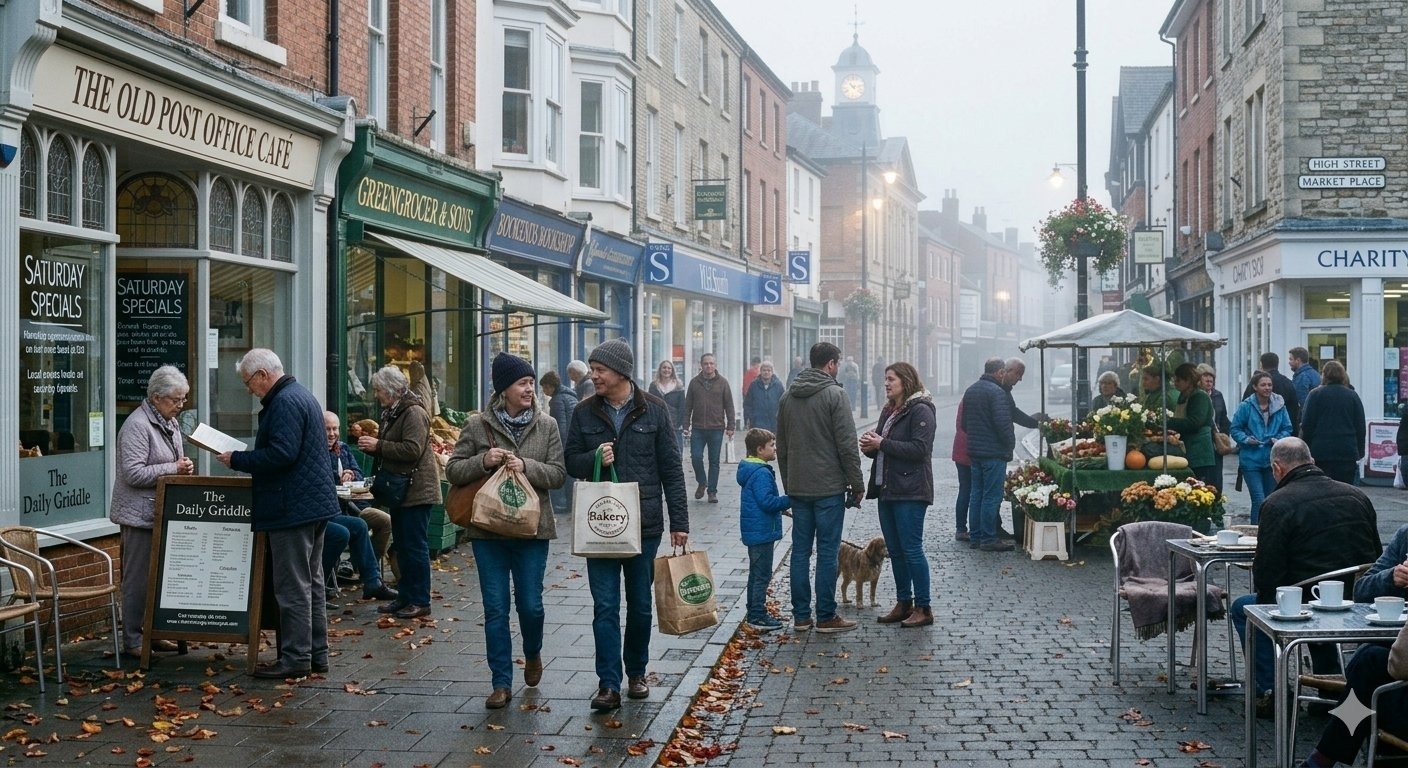
Image credit : Gemini
Not every weekend requires a countryside escape.
For many people, the local high street is enough. A walk past the bakery, a stop at the market, a few errands and a conversation with a familiar shopkeeper can fill a Saturday morning pleasantly.
Someone buys bread for lunch. Someone else chooses apples, vegetables or flowers. A family stops for a snack, while a friend suggests sitting down for coffee.
The bakery deserves a moment of attention.
Bread may appear to be one of the simplest foods, yet it connects agriculture with craftsmanship. Wheat is grown, harvested, milled into flour and transformed by the baker into loaves, rolls and pastries. Traditional British favourites include crusty loaves, soft rolls, fruit buns and scones, while modern bakeries offer breads and pastries influenced by many different countries.
A scone, made with flour, butter or another fat, milk and a raising agent, may be served with jam and clotted cream. The familiar combination is associated particularly with afternoon tea and the West Country, especially Devon and Cornwall, where people have their own preferred order for adding the cream and jam.
The small differences matter to people who grow up with these customs. Food can become a source of regional pride, affectionate disagreement and family memory.
And then there is tea.
Tea in the morning. Tea after a walk. Tea when a friend visits. Tea with a slice of cake.
“Would you like a cup of tea?” may be a genuine question about a drink, but it can also be an invitation to sit down, talk and stay a little longer.
Tea itself came to Britain through international trade and became increasingly woven into domestic life. Today, it belongs to countless ordinary moments, from a quick break at work to a leisurely afternoon at home.
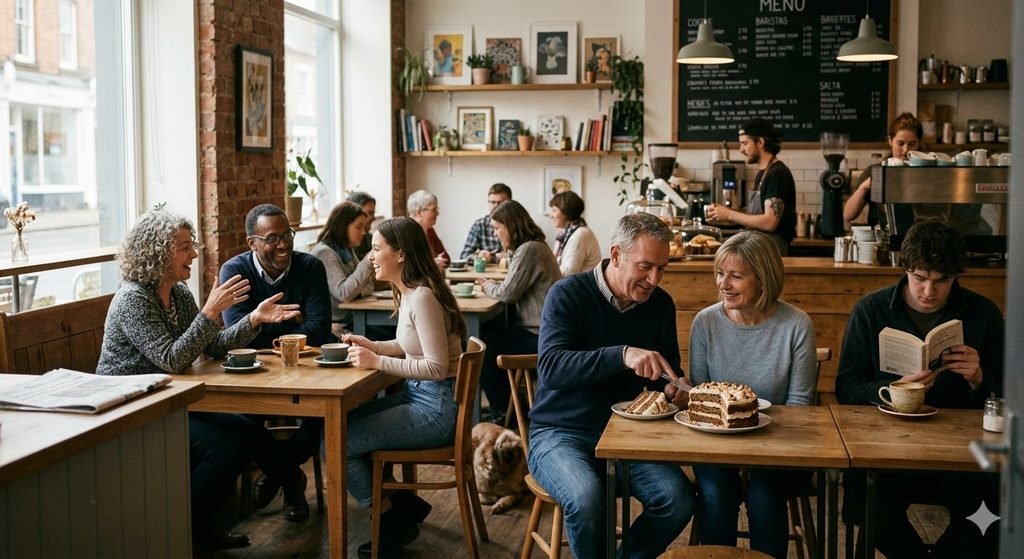
Image credit : Gemini
A café continues this tradition in a more public setting. Friends exchange news, a couple share a cake, and someone sitting alone enjoys a book beside a cup of coffee. The café is not always about a special occasion. Sometimes it simply offers a comfortable place to be among people without needing to speak to anyone.
Football, Friendship and the Local Pub
For many British families, Saturday afternoon brings another familiar possibility: football.
Children may be heading to training, parents may be standing beside a local pitch, and friends may be discussing the fortunes of their favourite clubs. Professional football attracts enormous attention, but the sport’s everyday presence is also visible in school teams, community clubs and informal games in parks.
A conversation can begin with a simple question about last week’s match and quickly become a spirited debate about a manager’s decisions, a missed opportunity or the prospects for the coming season.
Different generations may support different clubs, sometimes inherited through family traditions. A grandparent might remember a famous match from decades ago, while a teenager follows players through television and online highlights. Their knowledge may differ, but football gives them a shared language.
Of course, not everyone enjoys football. Some prefer cricket, rugby, cycling, swimming or a quieter walk. Others would rather spend the afternoon reading.
And for some adults, the local pub remains an important social setting.
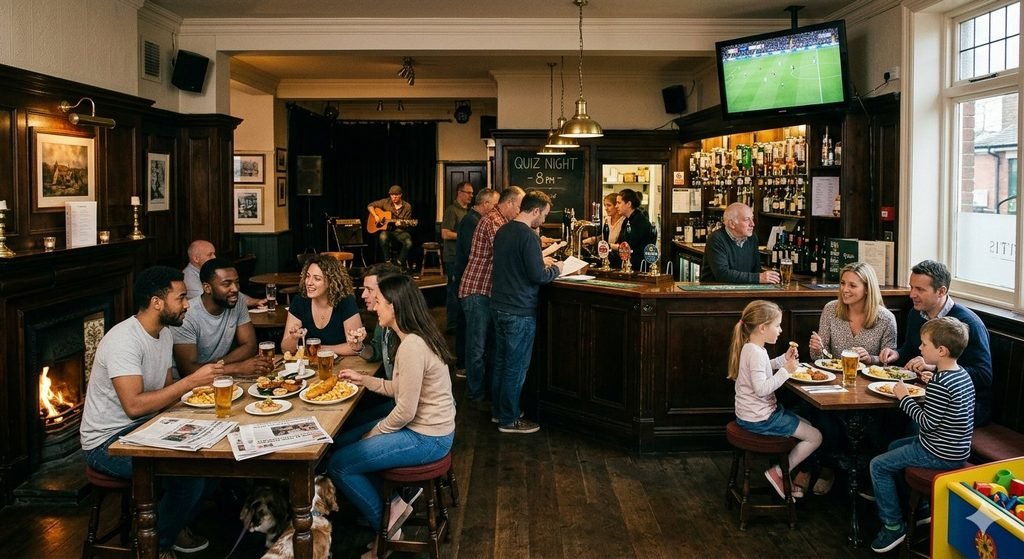
Image credit : Gemini
A traditional pub may offer meals, conversation, quizzes, live music or a place to watch a match. Friends meet there after work, neighbours catch up, and families may visit pubs that welcome children during suitable hours. The role of each pub varies, just as the people who use it vary.
Pubs are not the whole of British social life, nor does everyone visit one. Yet they can serve as familiar community spaces where people meet without having to arrange a formal occasion.
For some, the attraction is the company. For others, it is the food, the atmosphere or the simple pleasure of sitting somewhere familiar.
The wider lesson is not about a particular building. It is about the human need for places where friendship can continue beyond the home.
What the British Countryside Puts on the Table
By late afternoon, thoughts may turn towards food again.
Perhaps someone is planning a simple supper. Perhaps a family is preparing a meal for Sunday. A shopping bag contains potatoes, carrots, onions, apples or fresh vegetables, while the refrigerator holds milk, butter and cheese.
The connection between food and the British landscape becomes especially clear when we look beyond the kitchen.
Much of the country has a temperate maritime climate, with relatively mild temperatures compared with many continental regions, though rainfall, sunshine and local conditions vary considerably. These conditions, together with soils, topography and farming choices, shape what can be grown and raised in different areas.
Wheat and barley are important crops. Potatoes remain a familiar food. Dairy farming supplies milk, butter and cheese, while cattle and sheep are raised across extensive areas of grassland. Fruit and vegetables are grown in suitable regions, although much of the food eaten in Britain also comes from overseas.
This last point matters. The modern British kitchen is not confined to local produce. Rice, spices, tropical fruit, pasta and countless other ingredients reflect centuries of trade, migration and cultural exchange.
A family meal can therefore carry several histories at once: the history of local agriculture, the history of global trade and the personal history of whoever is cooking.
Imagine a grandparent explaining that the potatoes used to be prepared differently when they were young. Perhaps the family once bought vegetables from a market rather than a supermarket. Perhaps bread came from a small neighbourhood bakery, and meals were shaped more closely by what was available in a particular season.
The conversation need not become a lecture on agricultural history. A few memories are enough to show children that everyday life has changed, even when the dishes themselves remain familiar.
Food is a particularly gentle way of discovering the past because almost everyone has a story about something they loved eating as a child.
Sunday Morning: A Different Kind of Quiet
Sunday may begin more slowly.
Some people attend church, while others sleep later, prepare breakfast or take a walk. Families may have more time to sit together, although work schedules, household responsibilities and personal preferences differ widely.
For a household with children, Sunday morning might include cartoons, a book, a visit to grandparents or preparations for the coming school week. For someone living alone, it might mean reading the newspaper, listening to music or enjoying the quiet before the next working day.
Here, being an Indian, it amuses me a lot to know that in European societies grand parents stay away from their progeny. In India, generally three generations may stay together under one roof. And sacrifice of personal space has been regarded here as a cultural value. However European societies have their own values, which too are very remarkable. British grandparents can be very involved grandparents without being co-resident grandparents.
For example, a grandmother might collect her grandchildren from school on Friday, have them stay overnight, take them to a park or football match on Saturday, and return them home Sunday afternoon.
So the relationship can be intensive without being permanent.
And sometimes the grandparents’ own lives remain surprisingly active. They may have hobbies, travel plans, gardening, volunteering, clubs and friendships that are not centred entirely around their children.
However, what I feel is that neither system is perfect. The Indian arrangement can provide tremendous companionship and practical security, but it can sometimes reduce privacy or individual independence. On the other hand, British arrangement can preserve independence and personal space, but distance can become loneliness and formal care can become necessary when family support is insufficient.
Anyway, a Sunday walk can be as simple as a visit to a nearby park. In a village, it might follow a footpath past cottages and fields. In a town, it may lead through streets that feel quieter than they did on Saturday.
The quiet is not universal. Shopping centres, sports grounds, transport services and busy urban neighbourhoods can remain lively.
Britain has changed considerably from the days when Sunday activities were more strongly shaped by religious customs and restrictions on trade. Victorian literature often portrayed Sunday as quiet, restrained and even oppressive. The familiar picture is of closed shops, subdued streets, people in their best clothes and a general expectation that one should behave respectfully. And Dickens famously disliked it. His criticism is revealing: there was already a public argument within Victorian Britain about whether a Christian Sunday should be a day of joy and family recreation rather than simply prohibition. During the nineteenth and twentieth centuries, legislation gradually permitted more Sunday recreation. Cinemas received greater freedom in the twentieth century; museums, galleries and other forms of entertainment also became increasingly accessible.
Nevertheless, Sunday still carries a particular place in the imagination of many people: a day when there may be time to gather, cook, visit or simply slow down.
And in many homes, one meal gives this day a recognisable centre.
The Sunday Roast: More Than a Meal
Imagine a kitchen in which the oven has been working for some time.
The smell of roasting food begins to spread through the house. Potatoes are turning golden. Vegetables are being prepared. Someone checks the cooking, while another sets the table.
Sunday lunch is approaching.

Image credit : Gemini
The traditional Sunday roast may feature lamb, chicken or pork, accompanied by roast potatoes, vegetables, gravy and, in many English households, Yorkshire pudding. The exact combination varies by family, region, budget and preference. Some households prepare a vegetarian roast, while others choose a different meal altogether.
Yet the roast remains a powerful image of British family dining.
Its attraction lies partly in the food itself. Meat is roasted, potatoes develop crisp edges, vegetables bring their own sweetness, and gravy brings the elements together. Yorkshire pudding, made from a batter of flour, eggs and milk, adds another familiar feature to many traditional English roast dinners.
But the meal is also about timing and companionship.
Someone has spent time preparing it. Others may have helped with the vegetables, laid the table or washed up afterwards. Family members who have been occupied with different activities now sit together.
Conversation moves from school to work, from football to gardening, from a neighbour’s news to plans for the coming week.
A child asks a question. A grandparent tells a story. Someone requests another serving of potatoes.
In this ordinary scene, food performs a social role. It creates a reason to gather and gives the conversation a natural home.
The ingredients also connect the table with the land. Potatoes and vegetables grow in cultivated soil. Lamb come from livestock farming, often associated with Britain’s grasslands. Wheat provides flour for Yorkshire pudding and other baked foods.
The Sunday roast is therefore more than a familiar recipe. It brings together farming, cooking, family routines and the desire to share time.
For a visitor from India, where the main family meal may vary greatly from region to region, this is a recognisable human experience expressed through a different culinary tradition.
The dishes differ. The impulse to gather around food does not.
Puddings, Pies and the Sweet End of Sunday
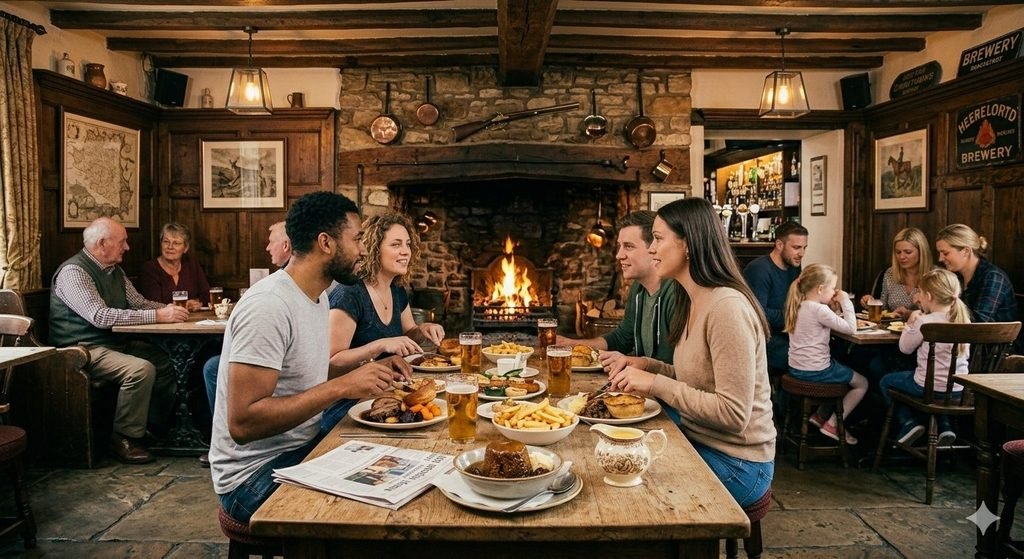
Image credit : Gemini
A British meal often leaves room for something sweet.
Perhaps the family has apple crumble, with cooked apples beneath a golden topping made from flour, butter and sugar. Perhaps there is a fruit pie, a sponge cake or sticky toffee pudding, whose rich sauce turns a modest portion into a memorable dessert.
Custard may accompany a warm pudding. A slice of Victoria sponge may appear beside a cup of tea. In summer, fresh berries can provide a lighter finish.
These desserts are worth noticing because they offer another glimpse of the countryside and the seasons.
Apples grow in orchards. Wheat becomes flour. Milk provides the basis for cream, butter and custard. Sugar, once a costly imported commodity, is now a common ingredient in domestic baking. The modern British dessert table reflects both local agriculture and the country’s wider history of trade.
Seasonality can still influence what people enjoy. Summer may bring berries and lighter desserts, while autumn encourages apple pies and crumbles. In colder weather, warm puddings and custard become especially inviting.
Of course, modern supermarkets make many ingredients available throughout the year. A family no longer needs to eat only what grows nearby or what is in season. Yet seasonal food continues to shape traditions, recipes and memories.
Perhaps someone remembers an apple pudding prepared by a parent. Someone else recalls helping to bake a cake for a birthday. A child may be more interested in licking the spoon than hearing about where the flour came from.
That is all right.
Food traditions are passed down in many ways: through recipes, repeated family meals, small kitchen tasks and the memories people attach to particular flavours.
The sweet course may last only a few minutes, but the memory of it can last much longer.
When the Weekend Moves Towards the Sea
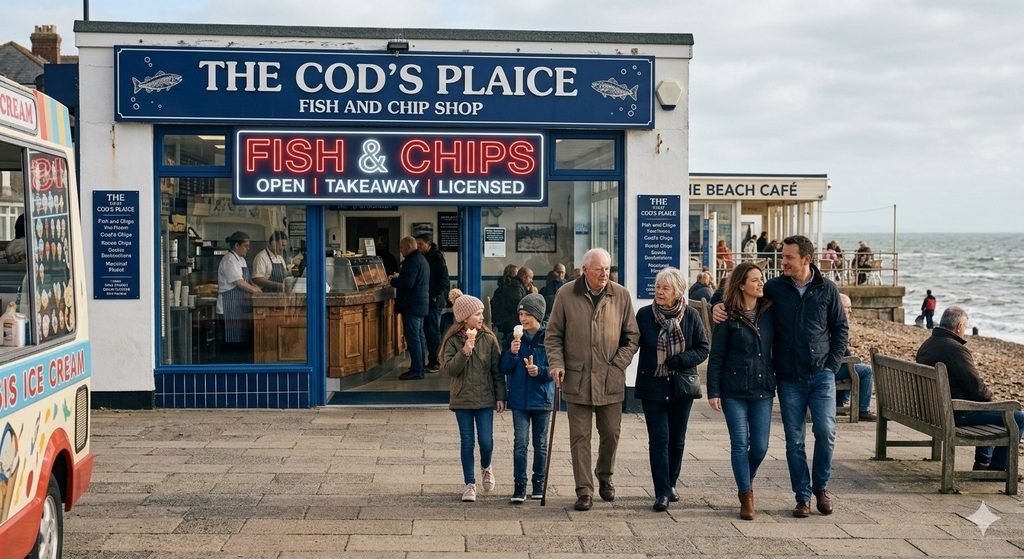
Image credit : Gemini
Not every British weekend remains close to home.
For some families, a day trip to the seaside offers a welcome change of scene. A coastal town may provide a promenade, a sandy beach, a harbour, small shops or a place to watch boats moving across the water.
Children may collect shells or build sandcastles. Adults may walk along the shore, sit on a bench or simply watch the changing sea. A family may visit a fish-and-chip shop, find a café or buy ice cream before heading home.
Fish and chips is one of Britain’s best-known casual meals. Fish is usually coated in batter and fried, while the chips are thick-cut pieces of potato. The dish has a long association with British working-class food culture and coastal towns, although it is now enjoyed in many different settings.
Its ingredients tell another simple story.
Fish connects the meal to the sea and fishing communities. Potatoes connect it to farming. The shop itself belongs to a wider history of urban life, transport, food preparation and changing working habits.
And then there is the ice cream.
It may have little to do with the local landscape, but it has much to do with the memory of the outing. Children remember the flavour, the coldness and the difficulty of eating it before it melts. Adults may remember a similar treat from their own childhood.
The seaside becomes more than a place to visit. It becomes a setting for shared memories.
The weather, naturally, remains unpredictable. A bright morning can turn windy, and a family that planned to stay until evening may decide to leave early. Yet even a brief visit can feel like a proper break from routine.
Perhaps that is the real attraction of a weekend excursion: it gives familiar people a different place in which to spend time together.
Books, Television and the Pleasure of Staying Home
Of course, there are weekends when the best outing is no outing at all.
The weather may be poor. The week may have been tiring. There may be household work to finish, or simply a wish to remain indoors.
Someone opens a book. Another person watches television. A teenager listens to music, while a parent catches up with a favourite programme. An older family member may enjoy a crossword, a newspaper or a quiet conversation over tea.
The home offers different kinds of leisure to different generations.
Children may want entertainment and company. Adults may want a little uninterrupted time. Older people may value familiar routines, though many remain active in community life, travel, hobbies and family activities.
Sometimes the household gathers around a film or a sports broadcast. At other times, everyone occupies a different corner of the home.
This need not mean that family life has become less meaningful. Sharing a home does not require everyone to do the same thing at the same time.
A weekend can offer both togetherness and privacy.
Perhaps a parent reads while a child draws nearby. Perhaps two generations watch a match together. Perhaps someone calls a relative who lives far away.
The small rituals of home may not attract attention from outside, but they are often what make a place feel familiar and secure.
Sunday Evening: Preparing to Begin Again
As Sunday evening approaches, the weekend starts to change character.
School bags are checked. Clothes may be prepared for Monday. Someone finishes a household task, while another looks at the coming week’s appointments. There may be a final cup of tea, a little television or a few pages of a book before bedtime.
For some, the transition is unwelcome. The freedom of the weekend is ending, and the alarm clock is waiting.
Others may feel ready for the structure of a new week. Work offers purpose, school brings friends and learning, and everyday responsibilities provide their own rhythm.
The weekend has not necessarily been spectacular. Perhaps there was no long journey, expensive meal or special event. The family may have stayed close to home, cooked familiar food, walked through the neighbourhood and spoken to a few friends.
Yet these ordinary hours have done something valuable.
They have made room for rest, for small pleasures, for companionship and for the freedom to choose how a little time should be spent.
And if the weather changed the plans, there may even be a story to tell about that.
What an Ordinary British Weekend Reveals
As an Indian observing British weekend life, I am struck not by one particular custom but by the many ways ordinary people try to make time meaningful.
A garden offers contact with nature. A village walk brings people closer to the countryside. A football match creates conversation across generations. A pub or café provides a place to meet. A Sunday roast gathers family members around a table. A seaside outing turns a simple meal into a memory.
Food quietly connects these experiences.
Sausages and eggs introduce the morning. Bread and tea accompany everyday conversation. Potatoes, vegetables, dairy products and meat reveal something about agriculture. Puddings bring fruit, flour and milk into family traditions. Fish and chips belong to the pleasures of a coastal visit.
Behind these foods are farmers, bakers, shopkeepers, cooks and many others whose work supports everyday life. Behind the rituals are older histories of work, leisure, trade, migration and changing family habits.
But the weekend is not a picture of a single kind of British family. Some people spend it with relatives, others with friends, and others alone. Some enjoy the countryside; others prefer busy towns. Some love sport, while others find their happiness in books, music, gardening or a quiet room.
The common thread is the desire to find a little space beyond the demands of the working week.
Perhaps the British weekend is best understood not as a collection of traditions but as a series of ordinary choices.
Shall we go for a walk?
Shall we make something nice for lunch?
Would you like a cup of tea?
Shall we stay home today?
These questions may sound small, yet they shape the hours in which families reconnect, friendships continue and memories quietly accumulate.
And somewhere outside, the weather is still making its own plans.
Perhaps the sun will return tomorrow. Perhaps it will rain again.
Either way, another weekend will come, bringing fresh possibilities for food, friendship, family and the simple pleasure of having a little time to call one’s own.
From Britain, our European weekend journey will move towards Poland, where another ordinary weekend will introduce us to different traditions of family life, food, community, changing seasons and the small pleasures that make a place feel like home.