Spain: Where the Weekend Becomes a Living Conversation
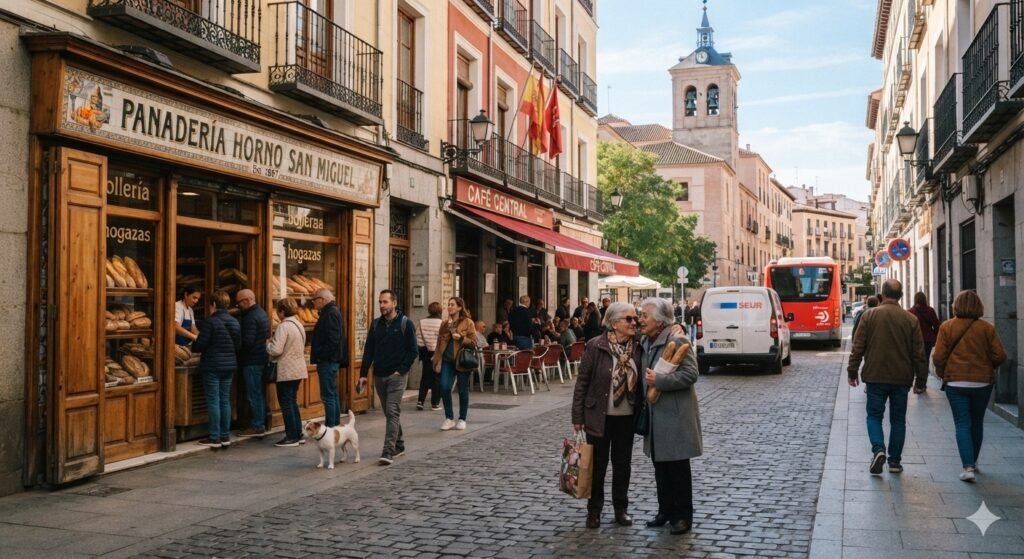
Image Credit : Gemini
Saturday morning arrives differently in every country.
In Spain, perhaps it begins with sunlight entering through half-open shutters, finding its way across a bedroom wall before the household is fully awake.
There is no great announcement that the weekend has begun.
The working week has simply loosened its grip.
A parent moves about the kitchen. Coffee is prepared. Bread appears on the table. Someone opens the window. A child, still reluctant to leave the warmth of bed, eventually wanders into the room.
Outside, the city is already beginning to breathe.
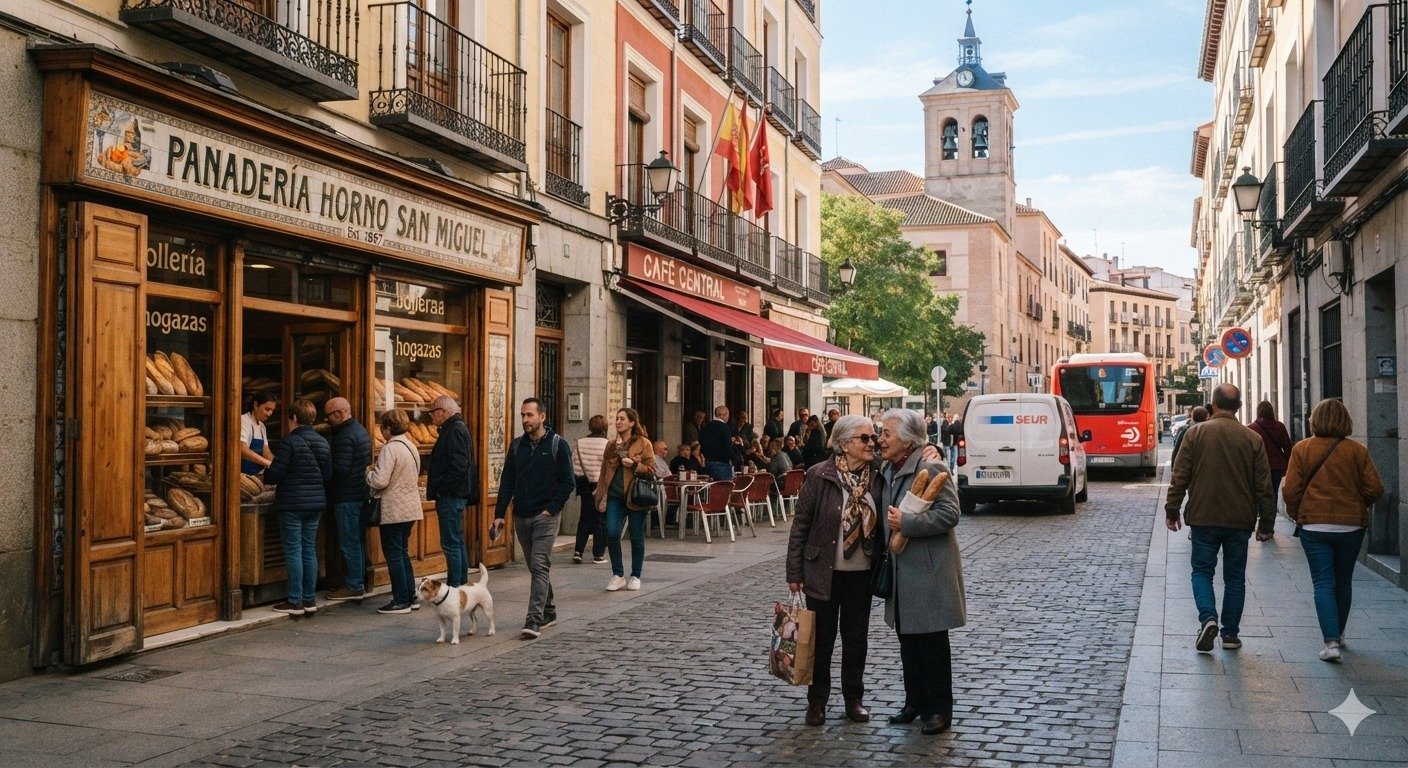
A bakery opens its doors. A few people walk towards a café. Delivery vans move through the streets. Neighbours exchange a quick greeting. Somewhere, church bells or the sound of traffic reminds everyone that the ordinary world has not disappeared.
But the rhythm has changed.
The weekend has arrived.
And as the morning develops, Spain begins to reveal itself—not through monuments or tourist attractions, but through the ordinary things people do when they have time to be together.
Saturday Morning: No Great Plans, Just the Weekend
Bread. Olive oil. Perhaps tomato. Coffee. Fruit. Maybe something sweet.
Image Credit : Gemini
The Spanish breakfast table may look simple.
Bread. Olive oil. Perhaps tomato. Coffee. Fruit. Maybe something sweet.
Yet look at it for a little longer and the table begins to speak.
The olive oil carries us towards the sunlit groves of southern and central Spain, where olive cultivation has shaped landscapes and livelihoods for centuries.
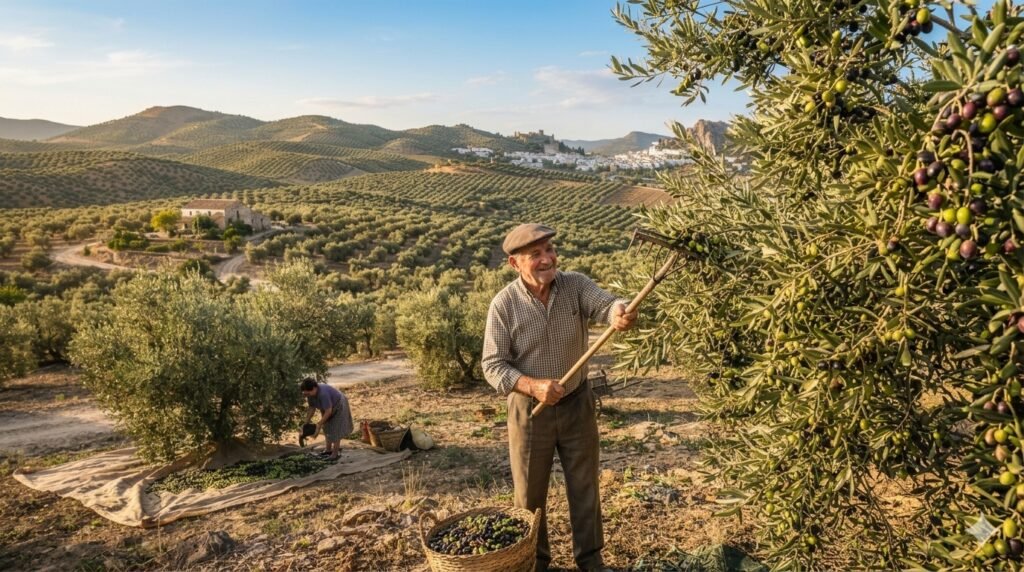
Image Credit : Gemini
The bread takes us towards fields of wheat and the agricultural traditions of the interior.
A tomato leads us somewhere much farther.
And that is where a seemingly ordinary weekend meal can suddenly become a conversation about history.
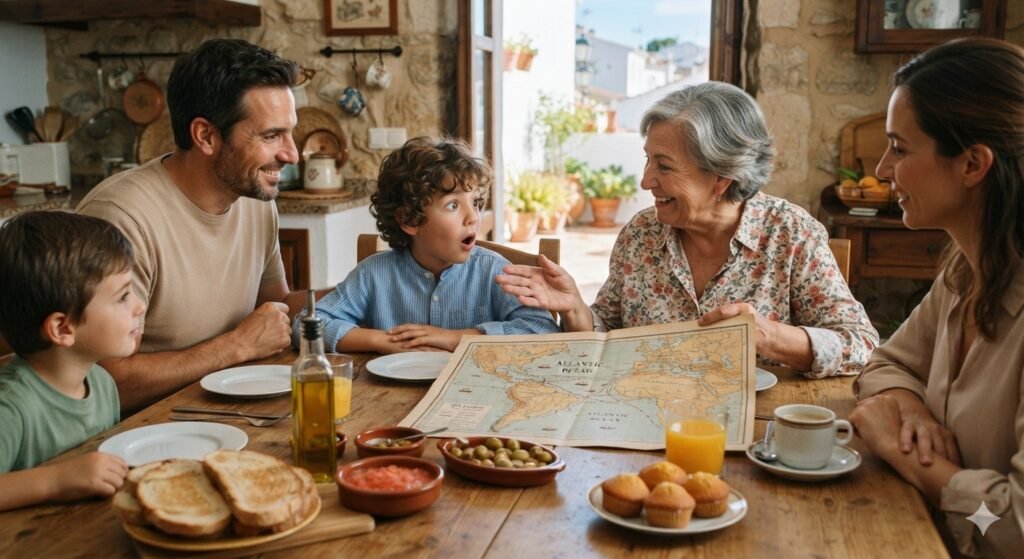
A child may ask:
“Were tomatoes always grown here?”
An older family member might smile.
“No. They came from the other side of the Atlantic.”
The child looks surprised.
“How?”
And suddenly breakfast has become a journey.
Centuries ago, Spanish voyages across the Atlantic connected Europe with lands previously unknown to Europeans. The encounters were enormously complicated, involving conquest, exploitation, exchange and profound consequences for Indigenous peoples. Yet they also began an exchange of plants, animals, foods and agricultural knowledge between the Old and New Worlds. Among the plants that eventually travelled eastward were tomatoes, potatoes, peppers, maize and cacao.
They did not immediately become the familiar foods we know today.
Plants have to meet a landscape.
They need the right soil, temperature, water and farming knowledge. Farmers experiment. Cooks adapt. Markets spread new ingredients. Families gradually incorporate them into familiar dishes. And then something remarkable happens.
After enough generations, the food no longer feels foreign.
It becomes home.
The Spanish breakfast table is not necessarily a grand one. It may be an ordinary kitchen table where the family sits together for a few minutes before everyone disappears into the activities of the day.
One child is talking about football.
Another is asking whether they can go out with friends.
Someone remembers that groceries are needed.
A parent checks the list.
“Do we have enough bread?”
“And tomatoes?”
“And milk?”
The weekend has begun.
Soon someone suggests going to the market.
That is enough to get everyone moving.
The family steps outside.
The streets are brighter now.
A visit to the market is not always treated as a serious household duty.
It can become part of the weekend.
There are vegetables, fruits, bread, cheese, fish and meat.
There are colours everywhere.
Red tomatoes.
Green peppers.
Oranges and lemons.
Olives.
Fresh bread.
Perhaps some regional specialities that the children know by name but cannot always explain.
Saturday Midday
By midday, everyone is hungry.
The family returns home with its shopping.
Someone begins preparing lunch.
The kitchen becomes busy. The children wander in and out.
Eventually, food reaches the table.
The meal continues.
People talk.
Someone tells a story.
Someone laughs.
The children become restless.
Saturday Afternoon: The House Opens Towards the Outside
After lunch, the house becomes quieter.
Someone rests.
Someone watches television.
A child reads.
Another child plays a game.
A teenager checks messages from friends.
Perhaps someone takes a short nap.
Perhaps there is some household work to finish.
The weekend is not necessarily an endless holiday.
Ordinary responsibilities remain. Laundry still exists. Shopping still needs to be done. The kitchen still needs cleaning. Homework may still be waiting.
But there is a difference.
These things do not completely control the day.
There is space around them.
Later, people begin going outside again.
A child may ride a bicycle. Friends meet. Someone walks the dog. Neighbours exchange greetings. Parents sit at a café. The simple pleasure of being outdoors becomes part of the afternoon.
Spain’s streets and public squares can be especially lively at such times.
People do not necessarily need a special reason to be there.
They can simply go out.
Walk.
Talk.
Sit.
Watch.
Meet.
And return home whenever they feel like it.
The Evening Begins Slowly
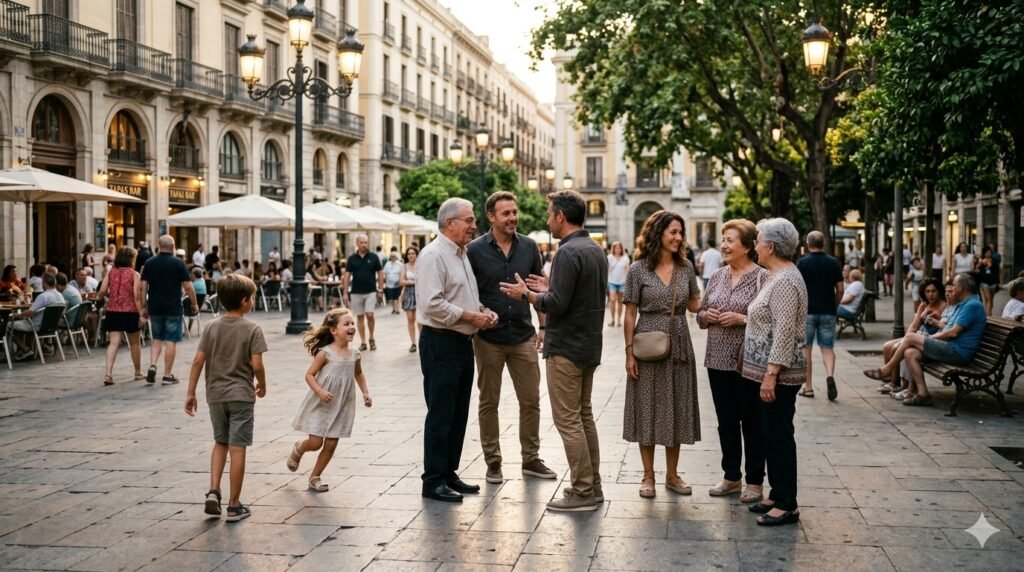
Image Credit : Gemini
As the afternoon fades, the streets change again.
The light softens. More people appear outside. Families walk together. Friends meet for a drink or a snack. Children continue playing. Older people sit and talk. A couple pauses outside a shop. Someone buys ice cream for the children.
The evening does not arrive as a sharp dividing line.
It grows gradually out of the afternoon.
Perhaps the family goes for a paseo—a simple evening walk. There may be no destination. The walk itself is enough. They see familiar faces. They stop for a few words.
The children run ahead and come back.
Someone suggests stopping for something to eat.
And suddenly the family is sitting outside a café.
Food Again—But This Time for Pleasure
Spanish weekend eating does not always need a special occasion.
A few small dishes shared among people can be enough.
Bread.
Olives.
Cheese.
Something fried or grilled.
Perhaps a regional speciality.
Perhaps something sweet afterwards.
The children are more interested in dessert than history.
The adults continue talking.
Someone orders another coffee.
The evening continues.
And somewhere in all this ordinary activity is a quiet lesson about Spanish life :
Food is not simply fuel.
It is often part of being together.
A meal can be a reason to sit.
A café can be a reason to meet.
A walk can be a reason to talk.
The activity itself may be simple.
The company gives it meaning.
Sunday: A Different Kind of Morning
Sunday morning feels different.
There may be fewer urgent errands.
The family wakes at its own pace.
Breakfast is slower.
Perhaps someone goes out to buy fresh bread.
Perhaps another family member visits a bakery.
The streets are quieter in some places and livelier in others.
Sunday has its own rhythm.
For some families, it means visiting relatives.
For others, it may mean sport, church, shopping, a walk, a drive into the countryside or simply staying home.
There is no single Spanish Sunday.
And that is important.
Spain is not one uniform culture.
A family in Madrid may spend its weekend differently from a family in Galicia, Valencia, Andalusia or the Basque Country.
The landscape changes.
The weather changes.
Local traditions change.
Food changes.
But ordinary family life connects them.
Visiting Grandparents
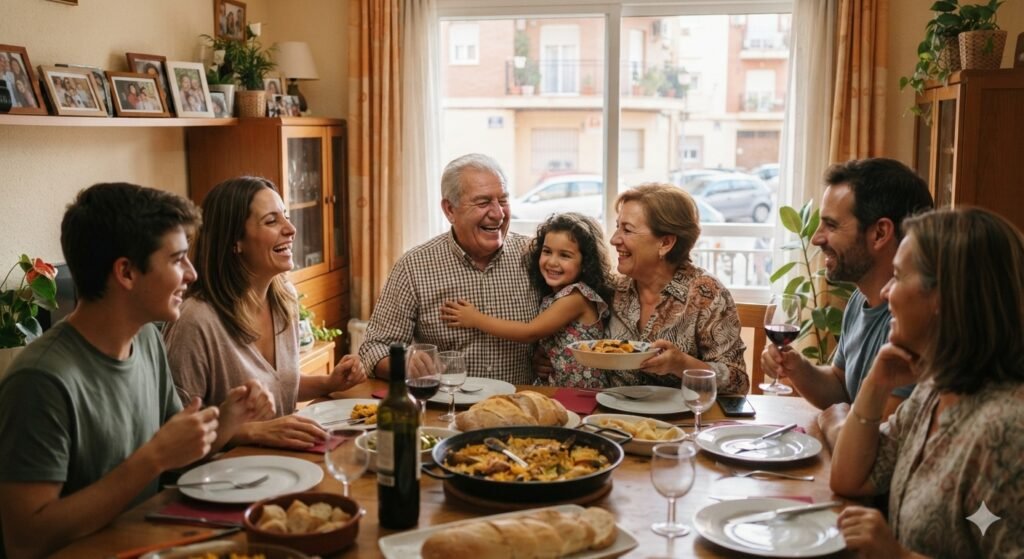
Image Credit : Gemini
For many families, Sunday is a good day for relatives.
Grandparents may come for lunch.
Or the family may visit them.
Children arrive with their usual energy.
Grandparents respond with their usual patience—or occasional complaints.
Someone asks about school.
Someone talks about work.
Someone remembers an old story.
And this is where another kind of history lives.
A grandparent may remember a town before a new road was built. Or, about a castle standing above a town. Perhaps about an old Roman road. Perhaps about a place shaped by centuries of Muslim presence in Al-Andalus. Perhaps about a medieval king, a local hero, a sailor, a battle or an ancestor whose name has almost disappeared from official history.
The story may not be perfectly chronological.
It may be told many times.
It may contain family exaggerations and small details that no historian would ever record.
But the child listens.
That is how history often enters ordinary life.
Not as a chapter in a textbook, but as a voice heard across a table.
Spain has lived through many layers of history: Roman Hispania, centuries of Muslim rule in parts of the peninsula, Christian kingdoms, the gradual expansion of Christian rule, the voyages across the Atlantic, the rise and decline of an empire, and the many political and cultural changes that followed.
These enormous historical movements eventually become smaller.
They become streets.
Buildings.
Names.
Festivals.
Recipes.
Family stories.
And memories.
The past becomes something people live beside.
They may remember how people travelled when cars were less common.
They may describe childhood games.
They may talk about food that was once prepared differently.
They may tell children about a family member who lived many years ago.
None of this appears in a history book.
Yet it is history.
It is family history.
And children often remember these stories long after they forget what they were taught in school.
When history arrives on the Sunday table
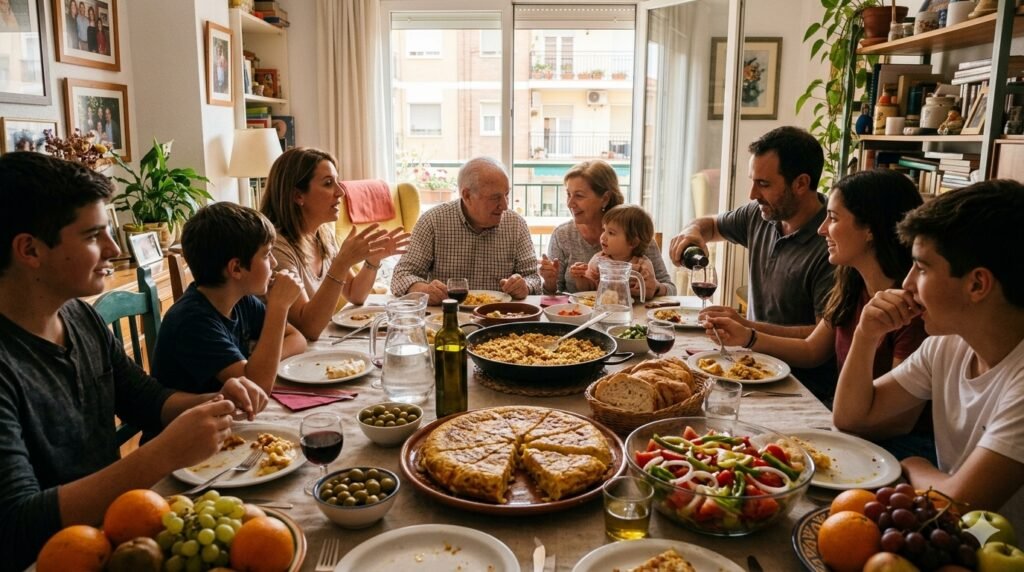
Image Credit : Gemini
By Sunday lunchtime, the family table is fuller.
Perhaps there is a tortilla española, its potatoes and eggs forming one of the most recognisable combinations in Spanish home cooking.
There may be a salad of tomatoes and peppers.
There may be rice, vegetables, bread, olive oil, fruit or a regional dish prepared according to a family recipe.
An older family member remembers how Sunday lunches were different when they were young.
Perhaps the furniture was different.
Perhaps the family was larger.
Perhaps meals were prepared over a slower fire.
Perhaps grandparents lived in the same house.
The details change from family to family.
But the basic pleasure remains remarkably familiar.
People sitting together.
Food in the middle of the table.
Conversation moving in every direction.
Nobody is in a hurry to finish.
For a while, the weekend seems to have stopped the clock.
The meal is not trying to tell anyone about history.
It is simply lunch.
Yet an elderly grandparent may look at the potatoes and say:
“Do you know where these came from?”
The child probably does not.
And so the story begins.
The potato originated in the Andes and eventually reached Europe through the Columbian Exchange. Over time, it became one of Europe’s most important food crops.
In Spain, it found a place in the kitchen that now feels completely natural.
The same is true of the tomato, peppers, Cacao, and Maize. Cacao gradually became part of European tastes for chocolate.
The family does not need to spend the afternoon discussing the sixteenth century.
Someone reaches for another piece of bread.
Someone asks for more food, waiting patiently to conclude these sixteenth century talks !
In Spain the food depends on the region and the family.
In one place there may be seafood.
Somewhere else there may be beans or a hearty meat dish.
Elsewhere there may be rice, vegetables or a dish closely associated with the local countryside.
The important thing is not to identify a single “Spanish meal.”
There isn’t one.
There are many.
And each region has developed its own relationship with its landscape.
But around the table, the differences become less important.
People are simply eating together.
Talking.
Laughing.
Remembering.
Planning.
Perhaps arguing about football.
Perhaps discussing Monday.
Perhaps telling the children to sit properly.
Ordinary life continues.
The Things That Make a Weekend
A weekend does not always need adventure.
Sometimes it is made of small things :
A fresh loaf of bread.
A walk after lunch.
A football match.
A visit to grandparents.
A trip to the market.
A coffee with a friend.
Children playing in the street.
A dog waiting patiently outside a shop.
A family sharing dessert.
A conversation that lasts longer than expected.
These things may look insignificant from the outside. But perhaps this is where lifestyle is actually created. Not in spectacular moments. In repeated ordinary moments.
Sunday Evening: Preparing to Return
Eventually Sunday begins to fade.
The family returns with mindset to restart works.
School things are prepared.
Clothes for Monday may be selected.
Someone checks the alarm.
The kitchen becomes quieter.
The children are told that it is time to sleep.
The weekend is almost over.
Yet outside, the streets may still have life in them.
People are walking.
Cafés remain open.
Families are returning from dinner.
Friends are saying goodbye.
The lights of the city begin to replace the afternoon sun.
For a few more hours, the weekend refuses to disappear completely.
And perhaps that is the most beautiful part.
A weekend does not have to be extraordinary to be memorable.
It can simply give people enough time to notice one another.
What an Ordinary Spanish Weekend Tells Us
After spending two days with this imaginary family, we may realise that there is nothing particularly exotic about their weekend.
They wake late.
They eat.
They shop.
They work around the house.
They visit relatives.
They meet friends.
They walk.
They sit in cafés.
Children play.
Adults talk.
They eat again.
They prepare for Monday.
In many ways, a family in Spain is doing what families everywhere do.
And yet every place gives these ordinary activities its own rhythm.
The food carries the landscape.
The streets carry the social life.
The recipes carry family memory.
The grandparents carry stories.
The public spaces carry conversations.
The evening carries a little more time outdoors.
And history quietly sits among all of them.
Perhaps that is what makes a weekend interesting.
We don’t have to travel through a country by visiting every monument. Sometimes we can understand it simply by watching a family spend two ordinary days. Spain’s history may reach back thousands of years. Its landscapes may stretch from mountains to Mediterranean shores. Its food may carry stories from distant continents. Its regional cultures may be wonderfully diverse. But on a Saturday morning, none of that needs to be explained. It simply reflects to the curious mindset.
What people wear also carries a history
By late morning, people begin stepping outside.
Modern Spain dresses much like any contemporary European country. Jeans, shirts, jackets, trainers, dresses and ordinary everyday clothing fill the streets.
But look more closely at the materials and a much older relationship with the land remains underneath.
Wool carries the history of sheep-rearing and pastoral life.
Linen recalls older traditions of plant-based fibres and Mediterranean clothing.
Leather carries connections with livestock, craft and rural life.
Cotton tells a different story—one increasingly linked with global trade, industrialisation and the expanding movement of materials across continents.
And in festivals and regional celebrations, older forms of dress still appear.
Andalusian, Basque, Catalan, Valencian and other regional traditions have their own distinctive clothing histories.
Modern Spain has not abandoned the past.
It simply does not wear all of it every day.
Sometimes history is kept in a wardrobe and brought out for a celebration.
Sometimes it survives in a fabric.
Sometimes it survives in a craft.
And sometimes it survives in a story.
And may be on a certain weekend day, a family conversation on breakfast table may start with clothing tradition in Spanish society!
A small glimpse of what comes next
Our journey through European weekends has already taken us through Germany, where rhythm and structure shaped the week; Sweden, where seasons, light and nature altered the emotional texture of time; Italy, where family, food, public spaces and the evening created another relationship with the weekend.
Spain has added another voice—the voice of sunlight, family, food, streets, history and celebration.
And our journey will continue.
Soon, we will cross another European landscape, where water, bicycles, quiet streets and an extraordinary relationship with the land will offer us yet another way of understanding the weekend.
The journey continues.