A Weekend in France: Where Ordinary Life Becomes a Way of Living
yes, certainly while composing a series of articles on ordinary weekend life in European countries; I have gradually begun to confirm my instinct that ordinary weekends in a country can tell volumes about its life, people and culture. And for a writer like me sitting in tropics, has a lot of curious introspections about these places and a huge opportunity to enjoy and interpret the geographical and cultural landscape of these lands. And if you are someone who loves this all; here evolves an interesting story about the lifestyle and culture of France.
When we look at another country, we often search for its identity in grand things—its monuments, museums, famous people, historical events or celebrated works of art. But perhaps a country reveals itself more honestly on an ordinary weekend.
The ambience around famous Eiffel Tower, or some famous museum or a celebrated boulevard will certainly not give you the kind of understanding about the life and people of France, which a neighborhood bakery, family sitting around a family table, or for that matter a nearby village market can bring it out before you. When the parents, children and grandparents decide what to do with a quiet Saturday afternoon, we can catch the life pulsating there.
After travelling through Germany, Sweden, Italy, Spain and the Netherlands in our European weekend journey, we now arrive in France.
And here, another kind of weekend rhythm begins.
A weekend of bread and conversation.
Markets and cafés.
Family meals.
Cycling and walking.
Children discovering the countryside.
Older people reading, talking or simply watching the world go by.
And, above all, the pleasure of taking time for things that might otherwise be hurried.
Saturday Morning: The Street Wakes Up, The Smell of Fresh Bread
Saturday morning begins with a familiar walk.
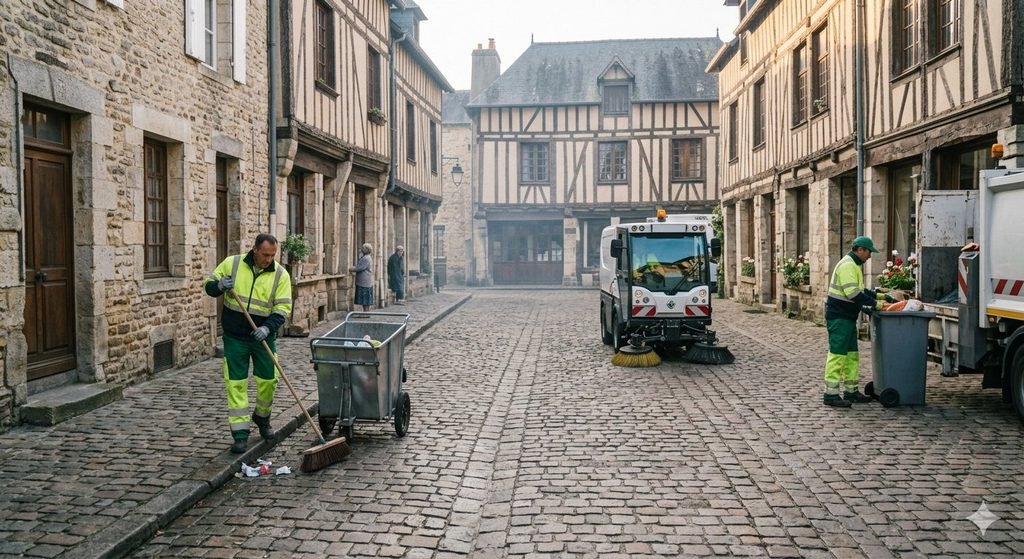
Image credit : Gemini
The street is gradually beginning to wake now.
But it is not only the residents who are getting ready for the day. Municipal workers are already there.
A street cleaner moves along the pavement with a broom and collection cart. Somewhere nearby, a small cleaning vehicle passes through the road. Waste bins are being emptied, leaves or litter are being gathered, and the traces left behind by yesterday’s busy street are slowly disappearing.
It is easy to notice a clean street and forget the people who make it possible.
Behind the quiet appearance of a French neighbourhood are thousands of workers whose day often begins before most residents are fully awake. In Paris, for example, thousands of municipal workers are involved in waste collection and street cleaning; other French cities have their own teams carrying out similar daily work.
For these workers, cleanliness is not an occasional activity. It is a daily routine.
And perhaps there is another side to this morning scene—the civic sense expected from the people who use these streets.
A public road is not simply the municipality’s responsibility. Residents are expected to put waste in the right place, follow collection rules and avoid leaving things behind for somebody else to clean. French municipalities themselves increasingly describe urban cleanliness as a shared responsibility between cleaning workers and citizens.
Yet, like any society, France is not free from careless behaviour.
Cigarette ends, litter, dog waste, graffiti and illegal dumping still create work for municipal teams. Paris has even identified recurring locations where bulky waste is illegally abandoned, while Nantes has reported large quantities of litter collected from public spaces.
So the morning street tells two stories at once.
One is about civic responsibility.
The other is about the human beings who have to repair the consequences when that responsibility is forgotten.
Now, with the street becoming cleaner and busier, the family can begin its own Saturday morning journey.
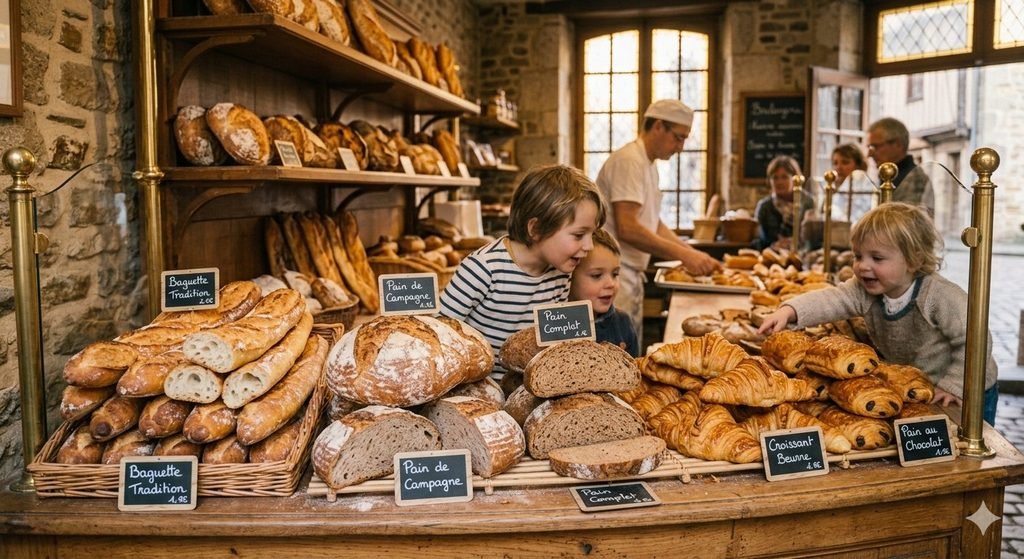
Image credit : Gemini
Someone needs bread.
So someone goes to the local boulangerie.
The shelves are already carrying the morning’s temptation. There is the familiar baguette, made mainly from flour, water, yeast and salt, its crisp golden crust hiding a soft, airy centre. Nearby may be a pain de campagne, the rustic country bread, often made with wheat flour and sometimes rye or whole-grain flour, with a deeper flavour and a chewier texture. A pain complet, made largely from whole-wheat flour, offers a darker, nuttier taste. And then there are the buttery croissants and pains au chocolat—technically pastries rather than everyday breads, but difficult for any child, or adult, to ignore.
For a moment, the choice is no longer simply about buying bread. It is about aroma, texture and memory. The smell of warm yeast, freshly baked flour and butter seems to travel beyond the bakery door and invite passers-by inside. After all, wherever we live, the language of the palate needs no translation.
Bread is such an ordinary thing that we can easily overlook its cultural importance.
In France, bread-making is part of a long tradition of craftsmanship, and the baguette itself has become one of the country’s most recognisable symbols. French bread-making traditions are even represented on UNESCO’s list of intangible cultural heritage.
But for the family standing in the bakery, none of this needs to be discussed.
They are simply buying breakfast.
That is how culture often survives.
Not as a lesson.
As a habit.
Perhaps the children have also come along to the boulangerie.
And, perhaps one parent has accompanied them while the other stays home preparing breakfast.
In many families, the small responsibilities of home and children are shared between parents in ways that may look quite ordinary—one prepares breakfast, another gets the children ready, someone packs the bags, someone remembers the day’s activities. Parenting, too, becomes a shared responsibility rather than something belonging to only one parent.
And, of course, not every French household follows the same pattern. Some couples choose to have children, while others decide not to. Modern family life can take different forms, and perhaps that variety is itself part of understanding contemporary France.
The Market Is More Than a Place to Shop
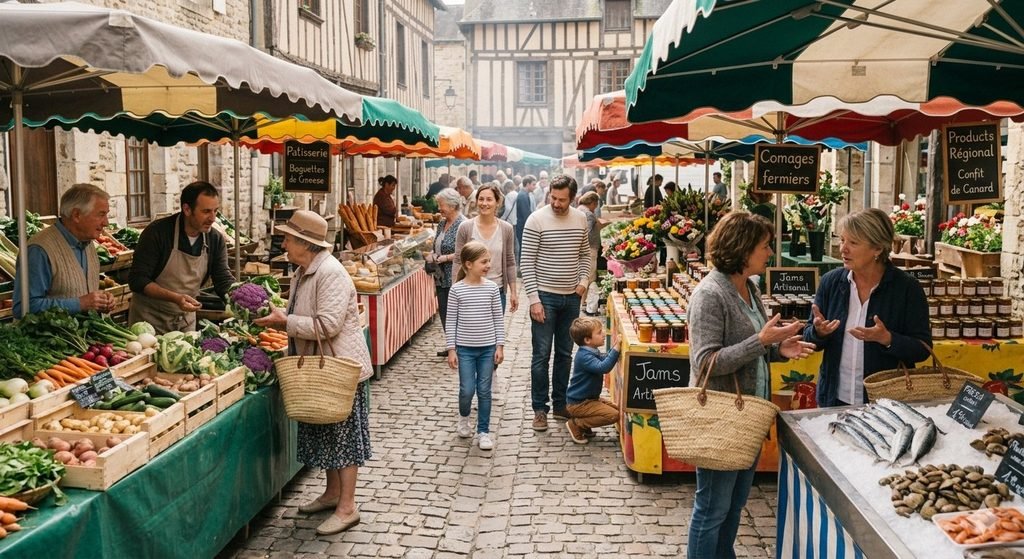
Image credit : Gemini
Later, the family may walk towards the local market.
This could be a covered market in a city or a weekly market in a small town.
There are vegetables.
Fruit.
Cheese.
Bread.
Fish.
Meat.
Flowers.
Jams and preserves.
Perhaps someone is selling honey.
Another stall has regional specialities.
A child stops to look at something colourful.
An elderly shopper discusses vegetables with the seller.
Two neighbours meet unexpectedly and begin talking.
The shopping takes longer than expected.
Nobody seems particularly worried.
This is one of the interesting things about a market.
You go there to buy something.
But you also go there to meet people.
French tourism authorities describe markets and covered food halls as places where people browse, taste, exchange ideas and meet local producers.
The market therefore becomes more than a commercial space.
It becomes part of the social life of the neighbourhood.
A Country on the Table
As the family walks between the stalls, France begins to reveal itself through geography.
The food of France is not one single cuisine.
It changes with the landscape.
In Provence, Mediterranean influences bring olive oil, vegetables, herbs and sun-loving produce.
In Normandy and Brittany, the Atlantic and cooler climate leave their own imprint.
In Burgundy, wine and regional cooking are deeply connected.
In the southwest, dishes such as cassoulet tell stories of local ingredients and older traditions.
In the Rhône Valley and Provence, fruits, nuts, herbs and olive oil appear naturally in the regional kitchen.
Even a market basket can therefore become a small map of France.
The country’s official tourism information emphasises precisely this connection between regional products, local markets, traditional skills and the idea of terroir—the character a place gives to its food.
A French family may not think about geography while buying cheese.
But geography is there.
It is simply sitting in the basket.
When History Arrives at the Table
There is another story hidden in the French kitchen—one that takes us far beyond the borders of France.
France was a colonial power for centuries, and those connections left traces in the country’s food culture. But the story is not simply one of France taking food from its colonies. It is a much more complicated story of movement—of ingredients, people, recipes and memories travelling across oceans.
Think of couscous.
Today it can be found on French tables and restaurant menus, yet its roots lie in North Africa. Its journey into everyday French life is connected not only with France’s colonial history in the Maghreb but also with later migration and the communities that carried their food traditions with them.
Then there is coffee, sugar and other tropical products whose histories are connected with colonial trade and plantation economies.
And in another direction, the French encounter with Vietnam created its own culinary exchange. French and Vietnamese food traditions met, adapted and continued to influence one another long after colonial rule ended.
So when a French family sits down for a weekend meal, history may be closer than it appears.
It may be in a bowl of couscous.
In a cup of coffee.
In a spice.
In a vegetable that once travelled across an ocean.
Food has a curious way of remembering history.
Governments may disappear.
Empires may end.
Borders may change.
But recipes can survive.
And sometimes they survive not because history was simple, but because ordinary people carried pieces of their old worlds into new ones.
Saturday Lunch: When Eating Takes Time
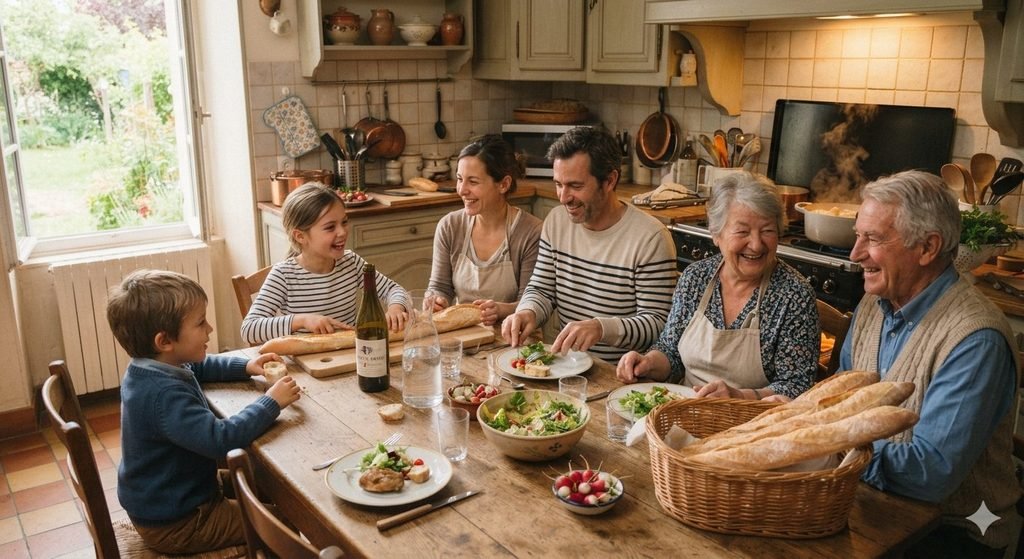
Image credit : Gemini
Back home, the kitchen becomes busy.
The bread is placed on the table.
Vegetables are washed.
Something is simmering.
Perhaps there is a simple salad.
Perhaps roast chicken.
Perhaps quiche.
Perhaps a regional dish.
The children are hungry.
Someone asks whether everyone is ready.
Then the family sits down.
There is no need to turn lunch into a formal ceremony.
Yet the meal may still take time.
People talk.
Someone tells a story.
A child interrupts.
A parent reminds the child to finish eating.
A grandparent may remember how a similar dish was prepared when they were young.
And suddenly, the kitchen travels a little further back in time.
They may tell the children how food was once cooked slowly over a wood or charcoal fire, in a heavy iron pot or earthenware dish, rather than in today’s modern oven. Vegetables were chopped with simple knives, dough was kneaded by hand, and a wooden spoon or ladle did much of the work that machines now perform.
Perhaps the grandparent remembers a family member stirring a pot for a long time, or bread being baked in a traditional village oven.
The children listen for a moment.
Then someone asks, “Was it really better that way?”
The grandparent smiles.
“Perhaps it simply tasted different.”
And the conversation returns to the meal on the table.
And suddenly, food has become memory.
This is one of the qualities that makes French food culture interesting.
The celebrated French gastronomic meal was added to UNESCO’s Representative List of the Intangible Cultural Heritage of Humanity in 2010. The recognition concerns not simply particular dishes but the wider social practice surrounding a meal—the selection of products, preparation, setting the table, eating and conversation.
So perhaps the real subject is not food.
It is being together around food.
Children Have Their Own France
While adults talk, children experience the meal differently.
They may be interested in the bread.
They may ask for another pastry.
They may dislike the cheese that everyone else seems to enjoy.
They may be fascinated by a strange-looking vegetable.
They may ask why one region eats something that another region does not.
And this is where food becomes an informal geography lesson.
A child may learn that olives are especially associated with the Mediterranean south.
That Normandy is famous for apples and dairy products.
That the southwest has its own hearty dishes.
That Brittany has buckwheat traditions.
That different parts of France have different cheeses, breads, pastries and sweets.
The country becomes understandable through taste.
And perhaps that is one of the gentlest ways to teach children about their own homeland.
Saturday Afternoon: The Neighbourhood Belongs to Everyone
After lunch, the family may go outside again.
Perhaps the children have sports.
Perhaps there is a park.
Perhaps they walk towards a small square.
Perhaps one parent wants to browse a bookshop while another sits at a café.
In a French town, the street can become an extension of home.
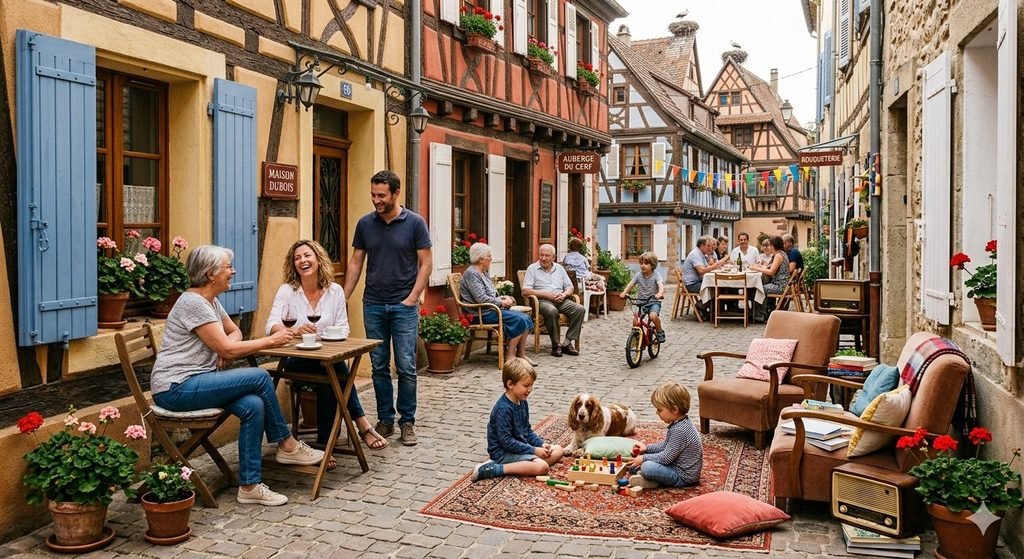
Image credit : Gemini
People walk.
Children play.
Older residents sit on benches.
Friends meet.
Someone takes a dog for a walk.
Cyclists pass.
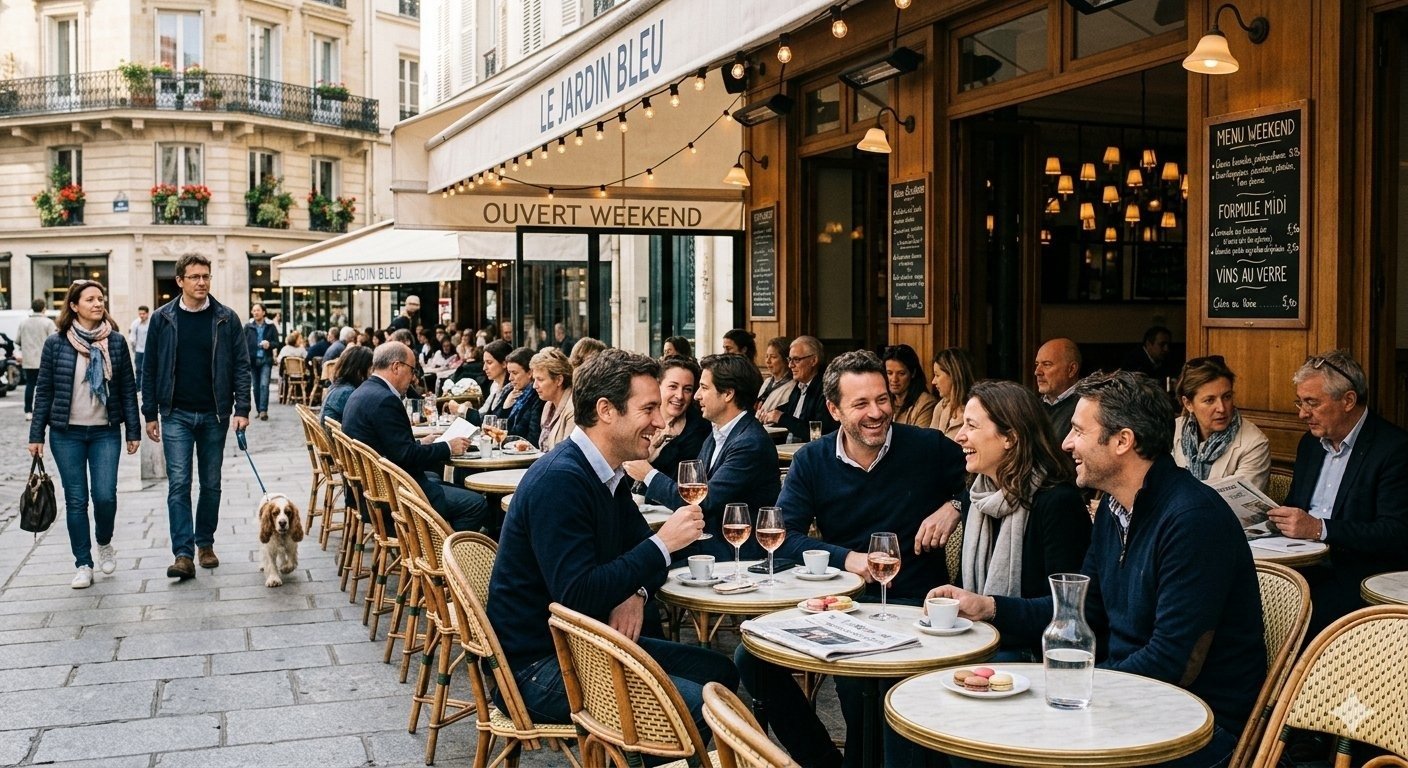
A café terrace begins filling with people.
The pleasure is not necessarily in doing something important.
It is in being outside.
France’s own tourism guidance frequently presents walking, cycling, village visits, cafés and outdoor life as ways of experiencing the country’s everyday rhythm.
And that rhythm changes from place to place.
Paris has one kind of weekend.
Lyon another.
A village in Provence another.
A coastal town in Brittany another.
A town in Normandy another.
There is no single French weekend.
There are many French weekends.
A Bicycle Ride Through the Countryside
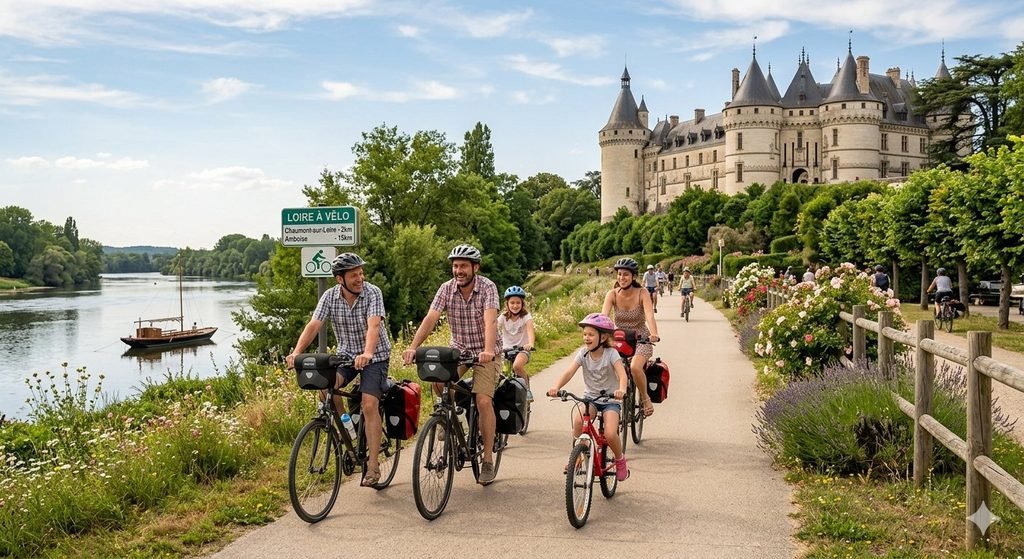
Image credit : Gemini
If the weather is pleasant, the family might decide to cycle.
France has developed a fascinating network of cycling routes where the bicycle is not merely a means of transport, but a gentle way of discovering the country. Some voies vertes, or greenways, take cyclists and pedestrians away from busy traffic and follow canals, rivers, forests or even old railway lines that have found a new life. Disused railway lines and canal towpaths are sometimes transformed into cycling routes. So a family may literally cycle through yesterday’s transport landscape. Major routes such as La Loire à Vélo or La Vélodyssée link villages, rivers, countryside, heritage sites and towns. France currently has a substantial network of waymarked cycling routes, including ten EuroVelo routes crossing the country. Interesting!
The children ride ahead.
A parent calls them back.
They stop beside a field.
Someone notices flowers.
Another child wants water.
Everyone rests.
France may not have quite the same everyday bicycle identity as the Netherlands, but cycling is an important part of leisure and travel in many parts of the country.
The French Countryside Has Many Faces
The countryside changes dramatically across France.
There are vineyards.
Orchards.
Wheat fields.
Sunflower fields.
Pastures.
Forests.
Rivers.
Mountain valleys.
Mediterranean landscapes.
Atlantic coasts.
The children may not know the names of everything they see.
But they notice.
They ask.
Why are these fields different?
What is growing there?
Why are the houses built from this kind of stone?
Why are the roofs shaped differently?
Why does the landscape look different from the place we visited last year?
An ordinary family outing can quietly awaken curiosity.
And once curiosity begins, geography becomes personal.
Saturday Evening: The Café, the Square and the Street
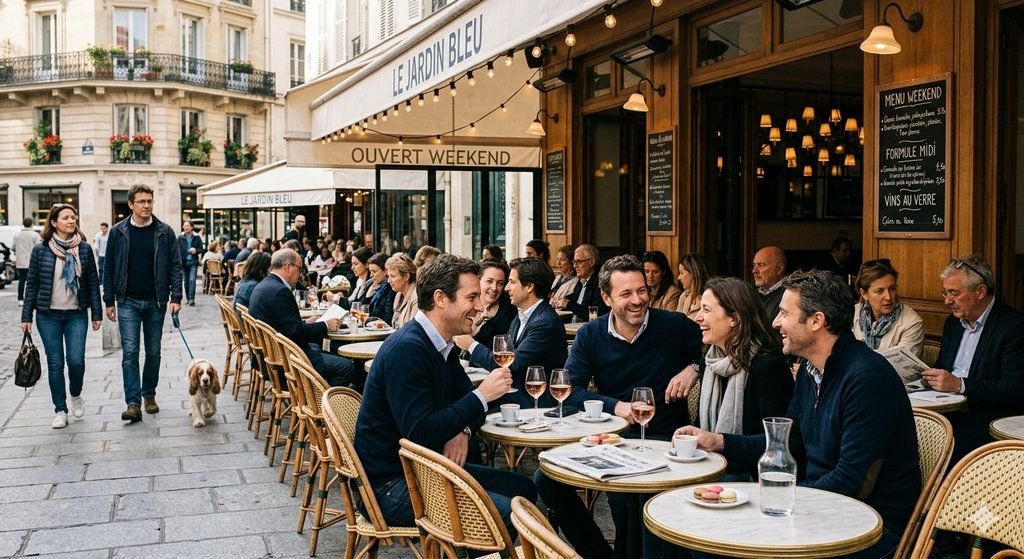
Image Credit : Gemini
By evening, the family returns to town.
Perhaps they stop at a café.
In France, Saturday evening might mean meeting friends at a neighbourhood café or restaurant, enjoying a long dinner, attending a concert, watching a film, or spending time at a family gathering. In larger cities, some people continue their evening in bars, music venues or lively streets. In smaller towns, the evening may be quieter, centred on dinner, conversation and friends.
Not every French person follows this pattern, of course. Families with young children, people working on Saturdays, and those who prefer a quiet evening all have their own routines. But for many, Saturday night can be an opportunity to socialise without worrying quite so much about the next morning.
A French national statistics study supports this general picture: its 2010 time-use data found that people spent more time going out or socialising on Saturdays, while Sundays tended to involve more rest and family activities, including about an extra hour of sleep compared with weekdays. This is a useful indication of the pattern, though not a description of every household today.
An interesting discussion on football matches might float over some tables at a cafe terrace.
For them, football is not only something watched on a screen. It can become friendship, rivalry, argument, laughter and a reason to meet. A child kicking a ball in the park may not yet understand the history of French football, but he or she already understands something important: a game can bring people together.
And perhaps that is another small window into a French weekend.
Adults have their cafés and markets.
Children have their games.
Young people have their football conversations.
The neighbourhood has room for all of them.
Sunday Morning: A Slower Beginning
Sunday morning feels different.
The household may wake later.
The street may be quieter.
Some shops are closed or have restricted hours, although opening rules vary and some shops in tourist areas and certain designated zones can open on Sundays.
There is less urgency.
Someone reads the newspaper.
Someone listens to music.
A child remains in bed longer than usual.
Perhaps there is a television programme.
Perhaps grandparents call.
Perhaps friends are coming for lunch.
Or perhaps the family simply enjoys the morning at home.
This quieter Sunday has an interesting place in French social life.
Research by France’s national statistics institute, INSEE, has examined Sunday as a time traditionally connected with family and social life, even as patterns of Sunday work and commerce have changed.
The modern weekend is certainly not identical to the old one.
But the desire for some shared time remains.
Sunday Lunch: The Table Becomes the Centre
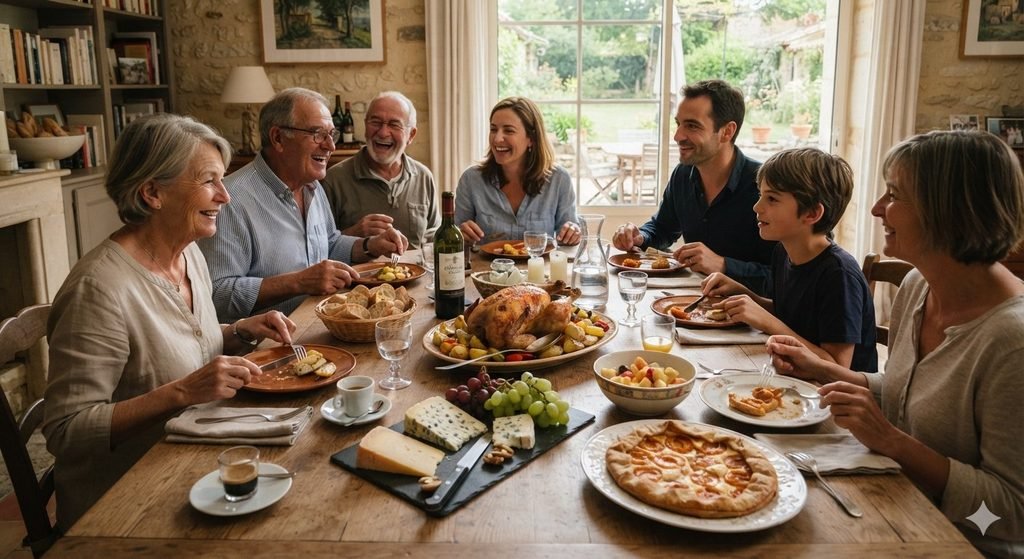
Image credit : Gemini
And then comes Sunday lunch.
Perhaps this is the meal the family has been looking forward to.
Someone has prepared something special.
Maybe roast chicken with potatoes.
Maybe a regional speciality.
Perhaps a tart or fruit dessert.
There may be cheese before dessert.
Bread remains on the table.
The meal stretches on.
Nobody seems eager to finish quickly.
Children talk.
Adults discuss the week.
Grandparents tell stories.
Someone remembers a family occasion from years ago.
A younger person asks a question.
The older generation answers.
And somewhere between the main course and dessert, a small piece of family history has been passed from one generation to another.
This is how traditions often survive.
Not through museums.
Through repetition.
A recipe.
A phrase.
A story.
A particular way of setting the table.
A dish that appears every Sunday.
The French gastronomic tradition itself places importance on the transmission of culinary knowledge between generations.
When Grandparents Become Storytellers
Perhaps this is also a moment when an Indian reader like me notices something familiar.
Grandparents sitting with children.
Children asking questions.
Stories moving backwards through time.
But the story may not always concern kings or famous battles.
It could be about a village.
A childhood bicycle.
A first job.
A family recipe.
A difficult winter.
A festival.
A house that no longer exists.
A neighbour who everyone remembers.
These ordinary memories can sometimes tell us more about a society than a textbook does.
A child may forget the exact date of a historical event.
But they may remember how their grandmother made a particular cake.
They may remember their grandfather’s story about walking to school.
They may remember the smell of bread on Sunday morning.
History enters childhood through the senses.
Sunday Afternoon: Where Should We Go?
After lunch, the family faces another important weekend question.
What shall we do now?
Perhaps the answer is a walk.
Perhaps a park.
Perhaps a museum.
Perhaps a garden.
Perhaps the countryside.
Perhaps a nearby village.
Perhaps nothing at all.
And that last possibility is worth remembering.
A weekend does not always have to be filled.
Sometimes people sit.
Read.
Listen to music.
Watch television.
Work in the garden.
Call a friend.
Repair something.
Play a board game.
Take the dog outside.
Or simply look out of the window.
Different generations naturally choose different forms of leisure.
Children may want movement and games.
Teenagers may want friends and music.
Parents may enjoy cooking, walking, cycling or meeting friends.
Older people may prefer reading, gardening, television, music or conversation.
A family weekend does not have to mean everyone doing the same thing.
Sometimes it simply means everyone having time to be themselves under the same roof.
Perhaps a Château Is Waiting
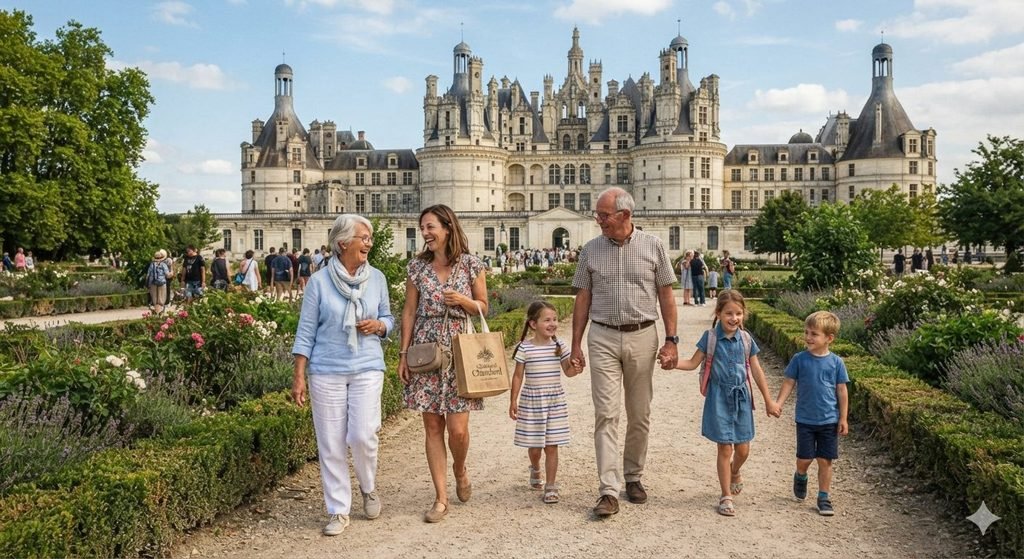
Image credit : Gemini
And then, on another weekend, the family may decide to go farther.
France has an extraordinary number of places where a short family outing can connect leisure with history.
A château.
A medieval village.
An old market town.
A garden.
A vineyard.
A river valley.
A historic railway.
The children may initially be interested only in running around.
But eventually someone tells them:
“People lived here hundreds of years ago.”
The question comes immediately:
“Who?”
And another story begins.
France’s heritage is not limited to Paris or its most famous monuments. The country’s villages, towns, regional traditions and craftsmanship form a much broader cultural landscape.
A weekend outing therefore has room for both pleasure and curiosity.
The children can climb steps in an old castle.
Parents can admire the architecture.
Grandparents can sit beneath a tree.
Someone buys ice cream.
History and ordinary life meet without anyone planning it.
A Little History on the Family Table
Back home that evening, someone may bring home a local product.
Perhaps cheese from the region.
Perhaps a jar of jam.
Perhaps a pastry.
Perhaps apples from a nearby orchard.
The children may ask where it came from.
The answer leads back to the countryside.
The countryside leads back to climate.
Climate leads to agriculture.
Agriculture leads to food.
And food leads back to the family table.
This is perhaps one of the most beautiful things about studying ordinary life.
Nothing is really separate.
A meal can contain geography.
A market can contain history.
A recipe can contain memory.
A bicycle ride can reveal the landscape.
A village square can reveal social habits.
A bakery can reveal craftsmanship.
The ordinary is rarely as ordinary as it first appears.
Sunday Evening: The Weekend Begins to Fold Away
By Sunday evening, the mood changes again.
The children prepare their school bags.
Parents think about Monday.
Clothes are arranged.
The kitchen is tidied.
Perhaps there is a simple evening meal.
Someone watches television.
Someone reads.
Someone listens to music.
A teenager exchanges messages with friends.
A parent checks the week’s calendar.
An older family member may sit quietly with a book.
The weekend is slowly disappearing.
Outside, the street becomes quieter.
The café tables are being cleared.
The last walkers return home.
The lights come on in the windows.
Monday is waiting.
Yet there is no need for sadness.
The weekend has done what it needed to do.
It gave the family time.
Time to eat.
Time to talk.
Time to wander.
Time to remember.
Time to discover.
Time to do nothing.
And perhaps most importantly, time to notice one another.
What France Adds to Our European Weekend Journey
As we move from country to country, the differences become increasingly interesting.
Germany gave us a feeling of structure and rhythm.
Sweden brought us closer to seasons, light and nature.
Italy showed us family, food, time and public spaces.
Spain opened its doors to sunlight, family, streets and celebration.
The Netherlands brought us water, bicycles and a close relationship with the landscape.
France adds another layer.
Perhaps it is the art of making ordinary moments worth lingering over.
A loaf of bread.
A market conversation.
A family lunch.
A walk through a village.
A bicycle ride.
A coffee at a pavement table.
A story told by a grandparent.
A book read quietly on Sunday afternoon.
None of these things is extraordinary.
And yet together they create a way of life.
Perhaps that is why a country cannot really be understood only through its monuments.
To understand a country, we should sometimes watch what its people do when nobody is trying to impress us.
Watch them buy bread.
Watch them meet neighbours.
Watch them prepare lunch.
Watch children play.
Watch grandparents talk.
Watch people walk home as evening arrives.
There, perhaps, we find something closer to the heart of a place.
The Quiet Lesson of a French Weekend
As an Indian watching this European journey from afar, I find myself returning again and again to one thought.
Our lives may look very different on the surface.
Our houses may be different.
Our food may be different.
Our streets may be different.
Our languages may be different.
Our family arrangements and weekend habits may also differ.
But the basic human desires keep appearing.
We want good food.
We want people to talk to.
We want children to enjoy themselves.
We want older people to feel connected.
We want a little time away from work.
We want places where neighbours can meet.
We want memories that our children will carry forward.
The forms change.
The human need remains.
And perhaps this is what our European weekend journey has been quietly discovering all along.
Behind the differences between countries lies a familiar human landscape.
A family around a table.
A child asking a question.
An old person telling a story.
A friend waiting at a café.
A bicycle leaning against a wall.
A market closing for the day.
The smell of bread drifting into a street.
The countryside waiting beyond the town.
And a Sunday evening slowly turning towards Monday.
France, like every country we have visited, has its grand history.
But perhaps its ordinary weekends tell another story.
A quieter one.
A story about taking pleasure in simple things.
About allowing meals to become conversations.
Markets to become meetings.
Walks to become discoveries.
And weekends to become something more than a pause between two working weeks.
Perhaps a weekend is also a small reminder of how we want to live.
And that may be the most interesting window through which to look at a country.
And the journey continues…
From France, our European weekend journey will move towards Britain.
There, another ordinary weekend will introduce us to a different landscape of family life—Sunday roasts, village walks, pubs and cafés, football, gardens, books, changing weather, seaside towns and the quiet rituals of home.
The journey continues.