A Weekend in the Netherlands: Where Water and the Bicycle Become Part of Everyday Life
When we look at another country, we often search for its identity in grand things—its monuments, museums, famous people, historical battles or celebrated works of art. But a nation’s character may sometimes be easier to discover in the things nobody thinks are remarkable.
How people travel to work.
How children go to school.
How neighbours greet one another.
What families put on the table on an ordinary Sunday.
How people use a public park, wait for a bus, shop for bread or spend an evening together.
These small habits are repeated thousands of times, by millions of people. Slowly, almost invisibly, they become culture. This time, my dear friends, wouldn’t it be interesting to look into the weekend life in the Netherlands and discover its people and culture through things that look so humble and ordinary ?
In the Netherlands, generally, there are no dramatic mountains on the horizon to look up to for a family, gazing through its window.
No great wilderness appears beyond the houses.
Instead, there is something else.
Water.
A canal runs beside the street.
Beyond it lies a stretch of green land.
Further away, a line of trees breaks the horizon.
The family wakes to a landscape that looks almost simple.
But it is a landscape that has been shaped, protected and lived with for generations.
And on a Dutch weekend, the relationship between people and this landscape becomes part of ordinary family life.
Saturday Morning: A Glimpse of Dutch Bicycle Culture
Breakfast is simple.
Bread.
Cheese.
Perhaps fruit.
Coffee or tea.
The children are already asking about the day’s plans.
Someone needs to buy groceries.
Someone wants to visit a friend.
Perhaps the family has planned a walk.
Perhaps there is a football match.
Perhaps they are going to a nearby town.
Nobody reaches for the car immediately.
The bicycles are outside.
One child checks the tyres.
Another looks for a jacket.
A parent puts a bag into a bicycle basket.
Then they leave.
When the Bicycle Becomes Part of Life
There is something interesting about the Dutch bicycle. It does not seem to announce itself.
A person gets on a bicycle to go to school, to work, to the supermarket, to the railway station, to a friend’s house or simply to cross town. There is no special occasion attached to it. It is simply how one goes about the day.
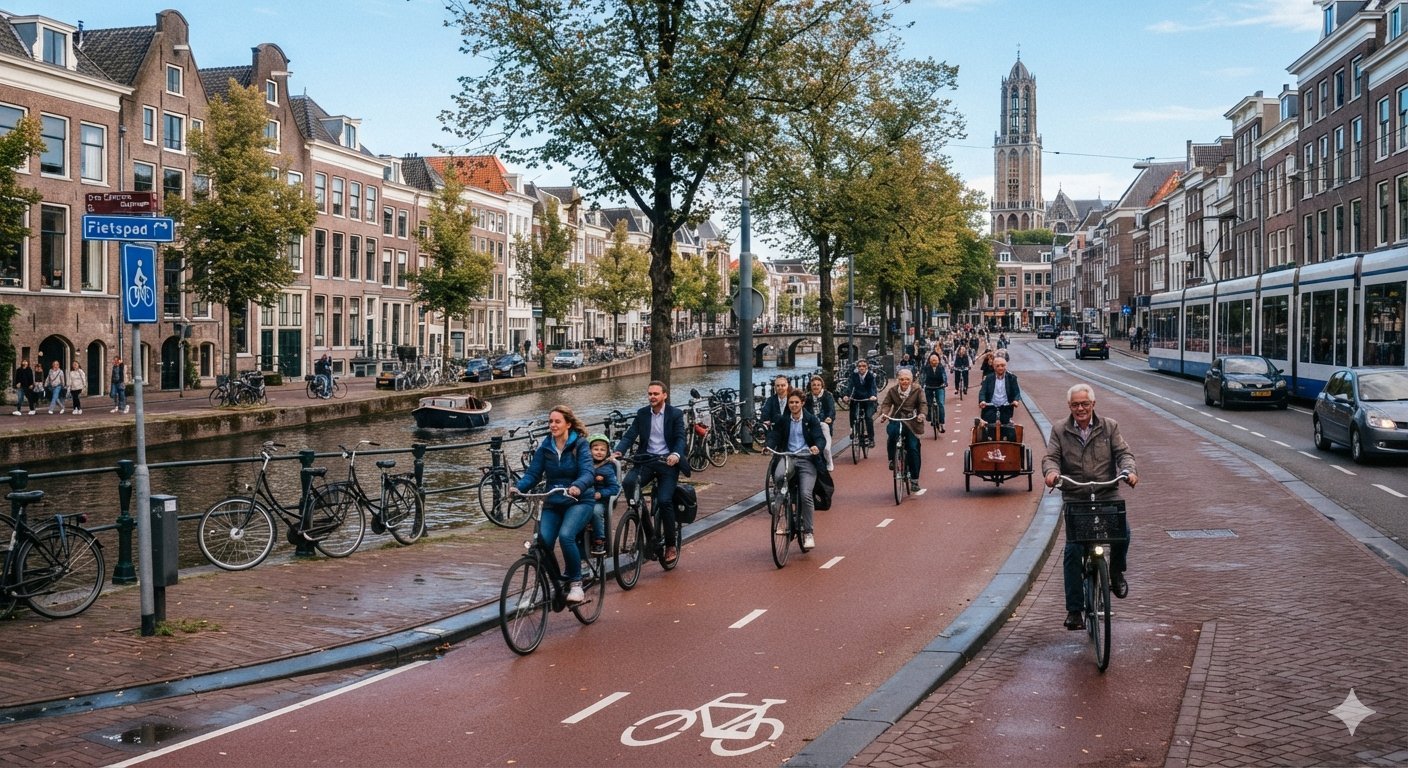
The Netherlands has more bicycles than people—about 22.8 million bicycles for a population of at least 17 million—and bicycles account for more than a quarter of all journeys. The country has also developed an extensive network of cycle paths, making the bicycle a practical part of everyday mobility rather than merely a recreational object.
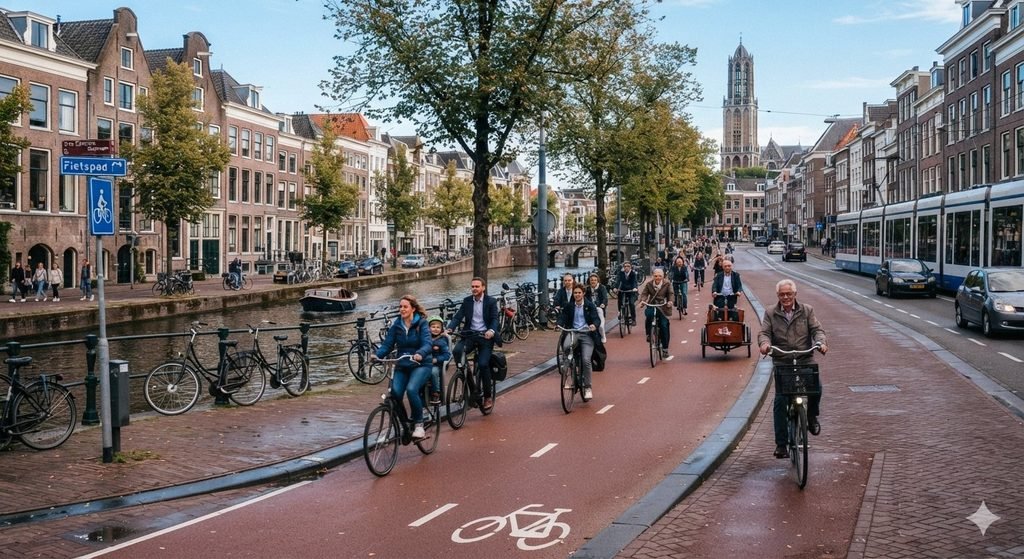
Image credit : Gemini
For a visitor, this can initially feel unusual. Imagine a Dutch family on a Saturday morning.
The parents are getting ready to go shopping. One child is already waiting outside with a schoolbag still hanging from the bicycle handlebar. Another has a football tucked away for later. Perhaps the youngest is travelling in a child seat or cargo bike. Nobody seems to be preparing for a special cycling trip. They are simply going somewhere.
And that is perhaps the most important thing about Dutch cycling culture.
The bicycle does not separate life from travel. It connects them.
A child learns more than balance
Dutch cycling begins early. Children are taught to ride and to understand traffic, and many schools include practical cycling education. Primary-school children commonly learn to travel more independently, and some take a cycling or traffic examination before moving on to secondary school.
Think of a child cycling to school on a weekday morning.
At first, the bicycle may be something a parent teaches the child to control. Gradually, it becomes something much bigger: a small piece of freedom.
The child no longer needs to be taken everywhere.
School is reachable. A friend’s house is reachable. The sports ground is reachable. A library, shop or park may be within cycling distance too.
So the bicycle quietly changes the geography of childhood.
A place that looked far away when seen from the back seat of a car can suddenly become part of a child’s own world.
The road becomes a social space
There is another subtle effect.
When people travel by bicycle, they remain much more exposed to their surroundings than they are inside a car. They see neighbours. They pass shopkeepers. They recognise the familiar faces going in the opposite direction. They stop at crossings, negotiate with other cyclists and pedestrians, and share the rhythm of the street.
Dutch cycling research describes this interaction with other road users as part of the social experience of cycling itself. Cycling can also help older people remain socially connected and participate in everyday activities for longer.
Imagine an elderly man cycling slowly towards the bakery on a Sunday morning.
He is not merely travelling from one point to another.
He may pause to greet someone he knows. He may see children heading towards a sports ground. He may exchange a few words with a neighbour waiting at a crossing. The journey itself becomes part of his social life.
This is one reason the bicycle feels different in the Netherlands. It is not necessarily about cycling faster. It is about making ordinary movement part of ordinary human contact.
A bicycle can carry a family
Dutch cycling also has a wonderfully practical side.
A bicycle does not always mean one person on one bicycle.
A parent may use a cargo bike to take children to school or collect groceries. Older children gradually gain independence and eventually ride on their own. Teenagers use bicycles to meet friends. Adults cycle to work or to the railway station. Older people may continue cycling for shopping, visiting friends or simply enjoying the surroundings.
The result is a rare kind of continuity: the same basic object accompanies people through many stages of life.
The Dutch government and cycling organisations have deliberately supported this culture through infrastructure, education and incentives. The practice has also been reinforced from one generation to the next: parents teach children, and those children often carry the habit into adulthood.
Perhaps that is why the Dutch bicycle feels less like a possession and more like a household companion.
A Dutch street can become a place where someone is going somewhere, someone else is returning home, children are travelling to school, an elderly neighbour is going shopping and two friends stop briefly to talk—all within the same small stretch of road.
Perhaps this is the real cultural story of the Dutch bicycle.
It did not simply make transportation easier.
Over generations, cycling became woven into childhood, independence, family life, work, friendship, ageing and neighbourhood life.
And on a quiet Dutch weekend, when bicycles appear everywhere—from the family home to the village bakery, from the railway station to the park—they quietly remind us that sometimes the character of a country can be seen not in its grand monuments, but in the ordinary way its people move through their day.
The Landscape Moves Past Slowly
As they cycle, the surroundings change.
Houses give way to open spaces.
A canal appears.
There are fields.
Ditches filled with water.
Bridges.
Trees.
Farm buildings.
Perhaps cows are grazing beyond a fence.
The land is remarkably flat.
And because there are few natural hills to interrupt the view, the sky seems enormous.
The child asks why there is water everywhere.
The parent explains that water has always been an important part of life here.
The Netherlands has a long history of managing water, including through dikes, drainage systems and polders—areas of land reclaimed from water and kept dry.
It sounds like a lesson in geography.
But the family is simply cycling through it.
The lesson is underneath their wheels.
When Water Becomes Part of the Neighbourhood
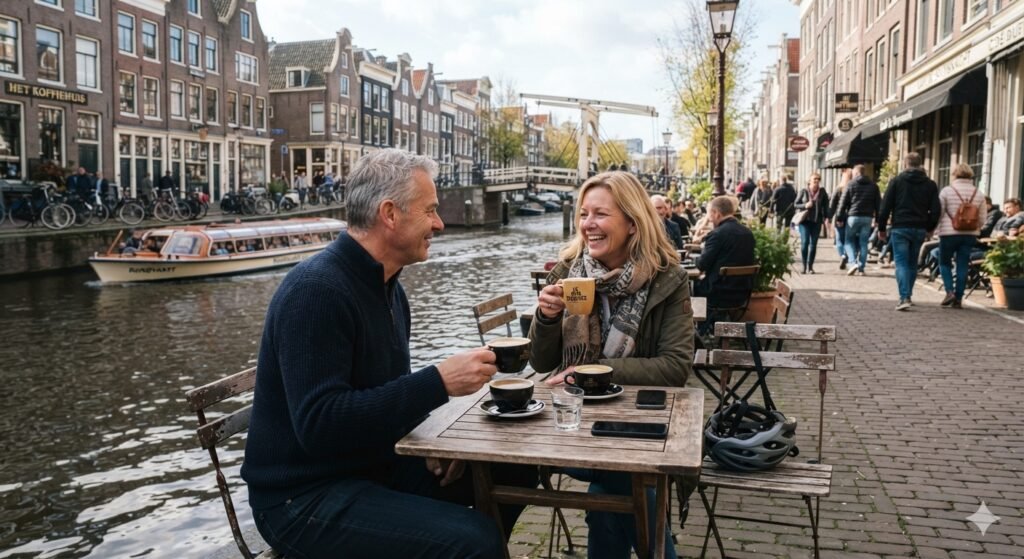
Image credit : Gemini
In many places, water is something people travel towards.
Here in the Netherlands, it can be something people live beside.
A significant part of the country is very low-lying. Some areas are below sea level, while rivers such as the Rhine, Meuse and Scheldt bring enormous amounts of water towards the North Sea.
So the Dutch historically faced two problems:
How do we keep water out?
and
How do we get water out when it comes in?
Canals became one of the answers.
The Dutch developed systems of ditches, drainage canals, dikes and pumping stations to move water from fields and low-lying areas towards rivers or the sea.
Historically, windmills became famous for pumping water from one level to another.
So when you see a network of narrow waterways beside Dutch fields, some of them are essentially part of a huge drainage system.
Generations later, these canals and windmills gradually became part of the visual and social character of Dutch life and a place to spend time on weekend too.
A canal can now be:
- a route for a small boat,
- a view from someone’s house,
- a walking path,
- a cycling landmark,
- a meeting place,
- part of a historic city centre,
- or simply something a child grows up seeing every day.
So infrastructure gradually became culture.
A canal may pass behind houses.
A small bridge may connect two streets.
A boat may move slowly past someone’s garden.
Children may stop to watch the water.
Adults may sit beside it with coffee.
On a warm weekend, people may go boating.
On another day, they may simply walk beside the canal.
The landscape quietly enters ordinary family life.
Saturday Afternoon: The Market and the Kitchen
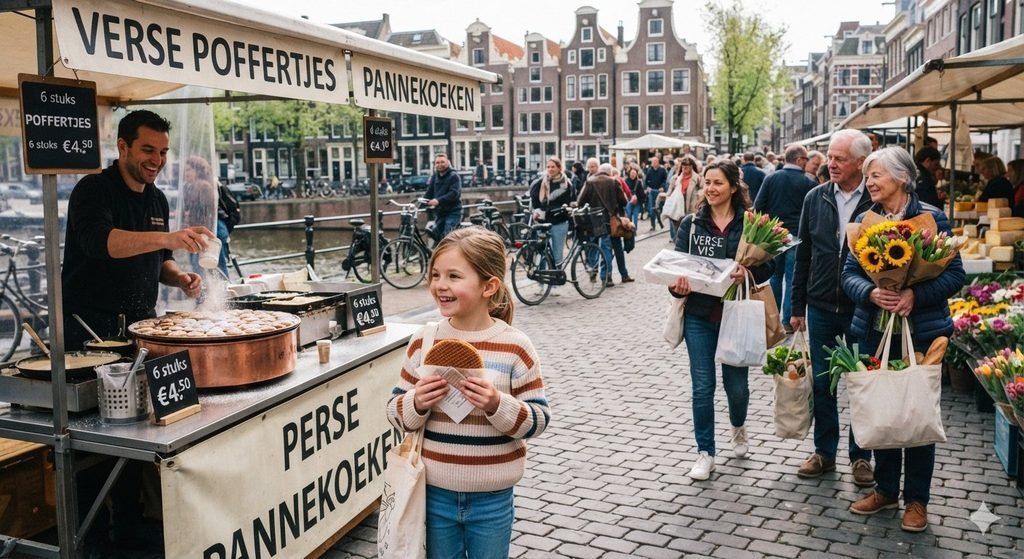
Image credit : Gemini
The family reaches the town centre.
There may be a market.
People arrive carrying baskets and bags.
Fresh vegetables are displayed.
Bread is stacked.
Cheese appears in many forms.
Herring, cod, mackerel and smoked eel appear among the fish at Dutch markets, reminders that the North Sea has long been more than a horizon—it has been part of the country’s kitchen. Herring is the great Dutch classic.
Flowers add colour to the scene. Beside the fish stalls, flowers brighten the market—roses, tulips, chrysanthemums, gerberas and, when the season arrives, peonies. The flowers seem almost to bring the Dutch landscape indoors.
The family buys what they need.
Fresh vegetables, bread, cheese and perhaps some fish go into the shopping bags. The flowers catch the adults’ attention.
But the children have noticed something else.
A stall selling poffertjes.
The little pancakes arrive warm, dusted with powdered sugar, and suddenly the children are much more interested in the market.
Perhaps another child is holding a stroopwafel, carefully biting through its crisp layers and sweet syrup filling.
It is a familiar scene in many countries. Adults may come to a market thinking about what the family needs for lunch or dinner; children often remember the little pleasure waiting somewhere between the vegetable stall and the bicycle stand.
For them, a Dutch market is not only about food and shopping. It is also about the smell of something warm, the excitement of choosing a treat, and the small sweetness that can turn an ordinary Saturday outing into a memorable one.
And again, geography appears without being announced. The sea, rivers, canals, fertile agricultural land and pasture have all played roles in shaping what people eat and produce.
The famous Dutch relationship with dairy products is easy to understand when you see the green grazing landscapes. Cheese is not simply something on a shop counter. It belongs to a landscape.
Lunch at Home
Back home, the shopping bags are unpacked.
Lunch is not necessarily an elaborate weekend ceremony.
There may be bread, cheese, vegetables, eggs or something simple prepared in the kitchen.
The family eats.
Someone talks about the morning.
The children argue about who rode faster.
One parent reminds them that bicycles are not racing machines.
Everyone laughs.
Outside, a cyclist passes.
A small boat moves along the canal.
The weekend continues.
There is no need to make everything into an event.
That may be one of the pleasures of ordinary life here.
Saturday Afternoon: Going Somewhere Without Going Far
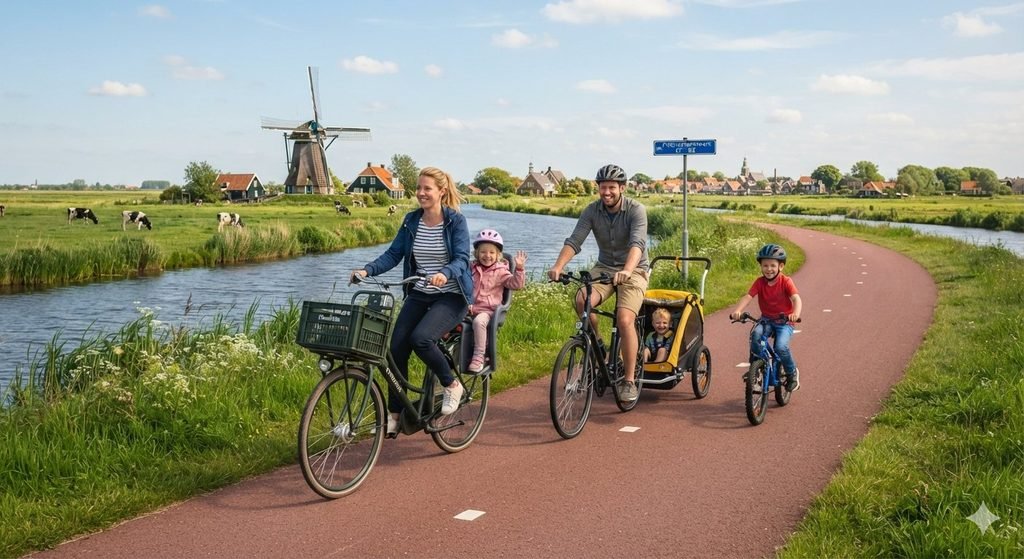
Image credit : Gemini
Later, the family may go outside.
Perhaps they ride towards a park.
Perhaps they follow a cycle path through the countryside.
The city gradually disappears.
The sounds become softer.
Wind moves across the fields.
Birds can be heard.
Water appears beside the path.
The children ride ahead.
The adults follow.
Nobody needs a complicated excursion.
The surroundings themselves provide enough interest.
A Dutch weekend can therefore have a special relationship with distance.
A place does not have to be far away to feel different.
A short bicycle ride can take a family from a busy neighbourhood into open countryside.
Saturday Evening: The Water Gets Quiet
By evening, the family returns home.
The bicycles are parked.
Shoes are removed.
Someone prepares dinner.
The children talk about the day’s ride.
Perhaps there is fish.
Perhaps vegetables and potatoes.
Perhaps a simple family meal.
The windows look towards the street.
The light begins to change.
Water reflects the evening sky.
A cyclist passes one last time.
A boat moves slowly along the canal.
The neighbourhood becomes quieter.
Yet the relationship with the outdoors has not ended.
The family may take an evening walk.
They may sit outside.
Perhaps friends visit.
Perhaps they stay home and watch something together.
The day has been active without becoming extraordinary.
Sunday Morning: A Different Kind of Freedom
Sunday begins more slowly.
There is no need to rush.
Someone makes coffee.
Someone opens the curtains.
The children are still sleepy.
Then the familiar question appears:
“What shall we do today?”
Perhaps the answer is to visit a windmill.
And The bicycles come out again.
A Weekend Visit to a Windmill
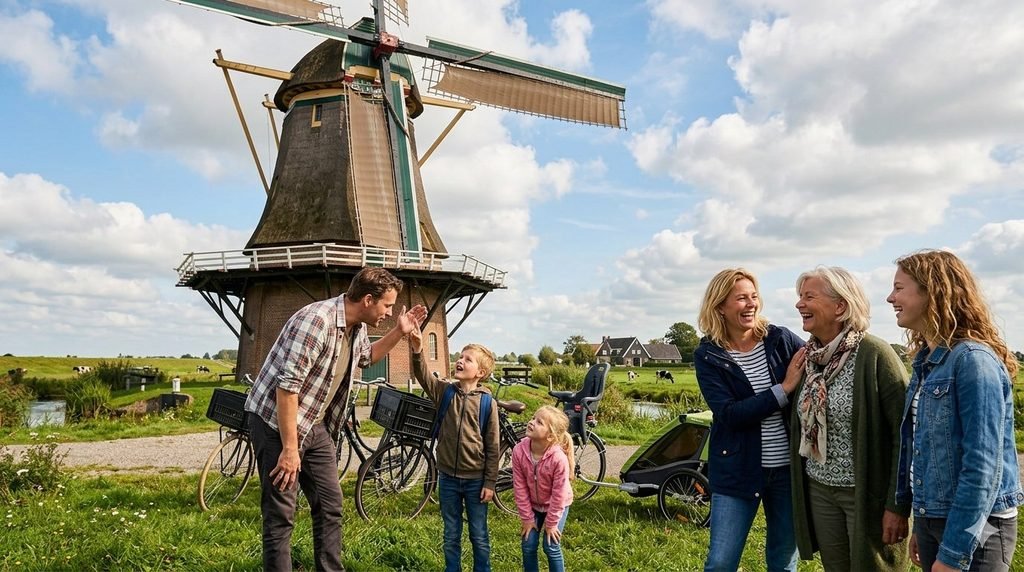
Image credit : Gemini
After taking breakfast, they cycle along a quiet road, following a canal that seems to stretch endlessly between fields. The youngest child suddenly points towards the horizon.
“There it is!”
A windmill is standing beside the water.
For the children, it may first look like something from a storybook—a tall wooden structure with enormous sails turning slowly in the wind.
But curiosity soon begins.
“Why are there so many windmills in the Netherlands?”
That simple question opens a door into Dutch history.
The family explains that these windmills were not built merely to make the landscape beautiful. For centuries, wind provided the power to operate machines that helped people manage water, grind grain and carry out other kinds of work.
Water management was particularly important in a country where large areas of land lie very low. The Dutch learned to use dikes, canals, sluices, pumps and wind-powered machinery together to control water and protect the land on which people lived and farmed.
The child looks again at the windmill.
“So it is pumping water?”
Sometimes, yes.
And suddenly the old structure looks different.
It is no longer simply a beautiful landmark.
It is a machine.
A machine that once helped people make a home on land that water might otherwise have claimed.
The parents may explain that modern electric pumping stations now do much of the work that windmills once performed. Yet some historic windmills remain operational, cared for as working monuments and reminders of the country’s long relationship with water.
The children walk closer.
The sails turn.
The wind moves across the fields.
A canal carries water quietly beside them.
And perhaps the youngest child asks one more question:
“Did people really build all this?”
The answer is complicated.
No single generation built the Netherlands. It was shaped over centuries by farmers, engineers, millers, water managers and ordinary communities who gradually learned how to live with a landscape that could never simply be taken for granted.
The family stands there for a while.
The children may be more interested in the moving sails than in the history lesson. Perhaps they run ahead along the path. Perhaps one of them begins imagining what it would be like to live inside a windmill.
But the adults see something more.
They see a landscape in which nature and human effort are difficult to separate.
The wind turns the sails.
The water moves through the canal.
The dikes hold their line.
The fields remain dry.
And the family cycles home.
The windmill remains behind them, turning slowly against the Dutch sky—as it has done for generations.
Perhaps that is why a Dutch windmill is more than a familiar symbol on a postcard.
It tells a quiet story about a people who learned that they could not command nature, but they could learn to work with it.
The family returns following a path beside a canal.
The youngest child asks questions.
Why are the fields so flat?
Where does the water go?
How deep is the canal?
Why are there so many bicycles?
The questions keep coming.
The parent answers some.
Others remain unanswered.
Perhaps that is fine.
The child is learning simply by looking.
Sunday Lunch: From Landscape to Table
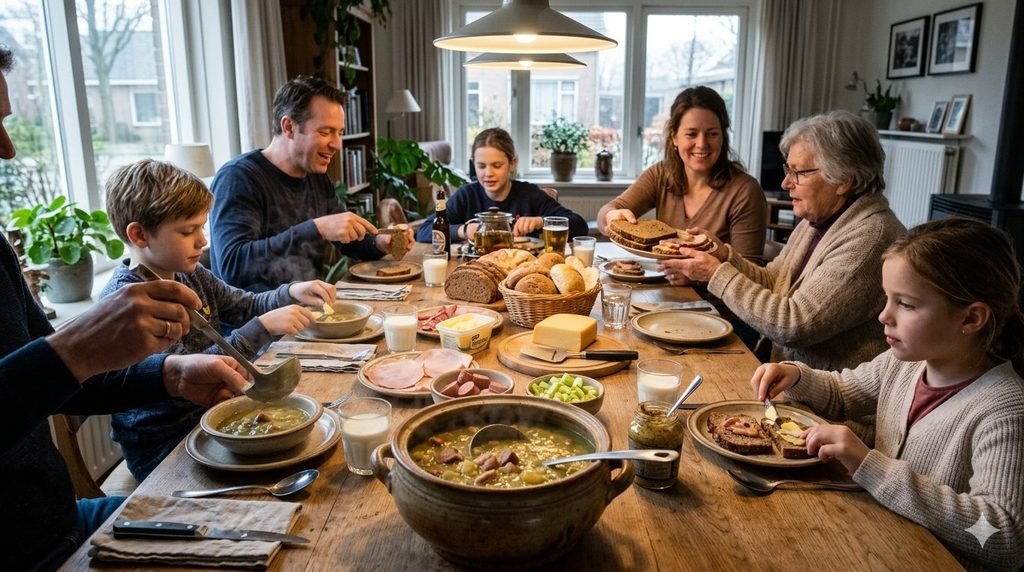
Image credit : Gemini
The family returns home.
The bicycles are parked. Jackets are hung up. Someone opens the kitchen window, and the smell of lunch begins to fill the house.
The Sunday table in a Dutch home need not look grand. But it can tell us quite a lot about the country.
On a cold Sunday, there might be a steaming bowl of erwtensoep, or snert—the thick Dutch pea soup made with split peas, vegetables and traditionally smoked sausage, often accompanied by rye bread. Another winter favourite is stamppot: potatoes mashed together with vegetables such as kale, sauerkraut or carrots, often served with a smoked sausage. Hutspot, made with mashed potatoes, carrots and onions, belongs to the same comforting family of dishes.
These are dishes that seem almost made for a grey, windy Sunday.
But Sunday lunch is not always about heavy winter food.
In warmer months, the table may become lighter—fresh vegetables, potatoes, salads, fish, bread and seasonal produce. The Dutch emphasis on seasonal ingredients can bring the countryside directly onto the plate: white asparagus from Limburg and North Brabant in spring, for example, or samphire from the salt marshes of Zeeland, traditionally served with fish or used in potato salad.
And then there are the dishes that make children suddenly more interested in what is happening at the table.
Pannenkoeken, Dutch pancakes, can turn an ordinary meal into something children look forward to. They may be eaten sweet or savoury, with ingredients ranging from fruit and syrup to cheese or bacon. Poffertjes, the little fluffy pancakes, are another favourite treat.
Perhaps there is an appeltaart waiting for later.
Perhaps there are stroopwafels, those thin waffle biscuits joined by a layer of syrupy caramel. The famous stroopwafel is traditionally associated with Gouda and dates back to the early nineteenth century.
And Dutch children have another particularly Dutch sweet habit to discover: drop, or liquorice. It can be sweet, but much Dutch liquorice is distinctly salty—a flavour that may surprise a visitor who expects a conventional sweet.
A Sunday Table That Changes with the Region
The further we travel through the Netherlands, the more interesting the table becomes.
In Limburg, spring brings the celebrated white asparagus, sometimes called the region’s “white gold”. It may be served traditionally with butter sauce, parsley, boiled egg and ham.
In Zeeland, the influence of the sea appears in the food. Samphire grows in the region’s salt marshes and has a naturally salty flavour. It is traditionally paired with fish or added to potato salad.
In North Brabant, food has a particularly strong association with gezelligheid—the Dutch idea of warmth and conviviality. The region is known for its Brabantse worstenbroodje, a sausage roll whose origins lie in the practical tradition of wrapping meat in dough to preserve it. In summer, Brabant even celebrates a curious combination of local produce: asparagus, strawberries and anchovies—the region’s so-called “Triple A.”
And in Groningen, there is the eierbal—a whole boiled egg surrounded by a seasoned ragout coating and fried. It emerged in the post-war period and became an inexpensive, filling regional snack.
Suddenly, the Sunday table is no longer just a meal.
It has become a map.
The asparagus tells us about the soil of Limburg.
The samphire reminds us of Zeeland’s salty marshes.
Fish takes us back towards the North Sea.
Potatoes and vegetables connect us with the agricultural landscape.
Bread, cheese and dairy products speak quietly of the country’s farming traditions.
And the sweet things tell another story altogether—the story of children waiting for their turn.
Sunday Afternoon: The Country Opens Out
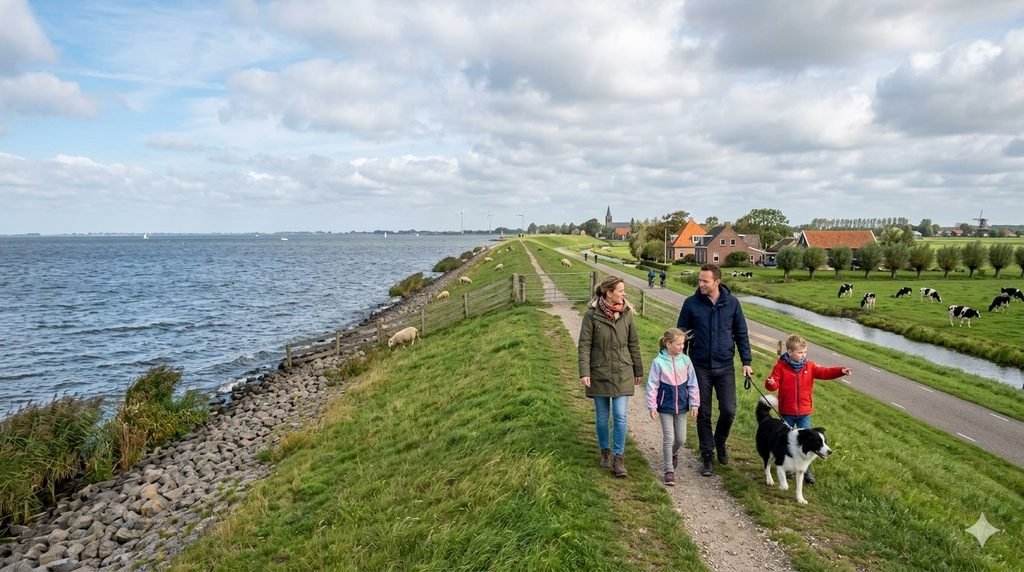
Image credit : Gemini
After lunch, perhaps the family goes outside once more.
This time they may visit a lake, a park, a beach or another town.
The Netherlands offers many ways to experience water.
There are canals in cities.
Rivers crossing the country.
Lakes.
Wetlands.
The North Sea coast.
And everywhere, there is a reminder that land and water are closely connected.
The family may walk along a dike.
From one side, they can see water.
From the other, fields or houses.
A child runs ahead.
Someone stops to take a photograph.
A bird crosses the sky.
The wind is strong.
The adults pull their jackets closer.
Nobody complains.
The wind is part of the landscape too.
Sunday Evening: When the House Becomes Quiet
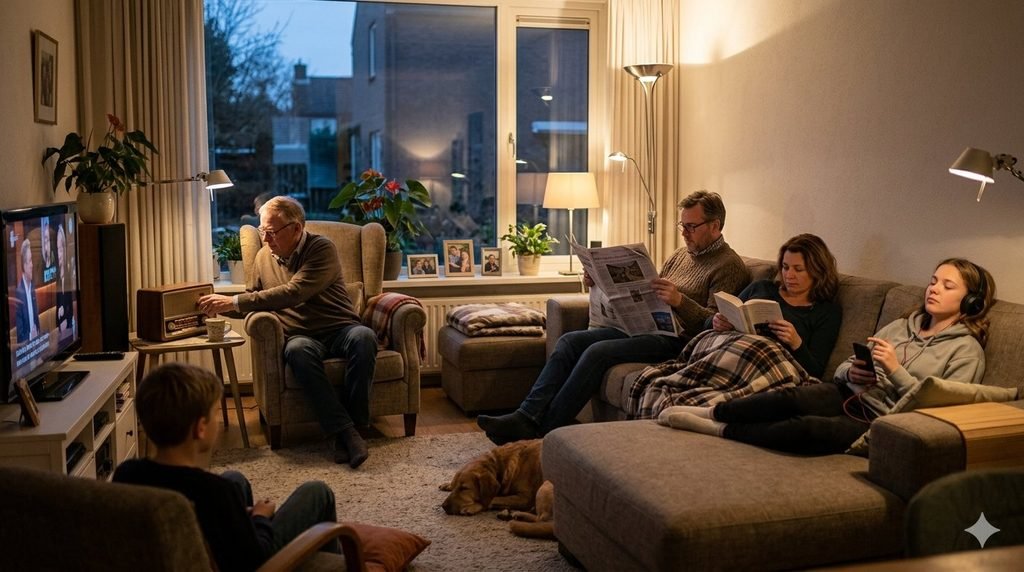
Image credit : Gemini
After a day of cycling, walking and being outdoors, Sunday evening brings another kind of pleasure.
The bicycles are back in their places.
The muddy shoes have been cleaned.
The kitchen has become quiet.
Someone makes coffee or tea.
And gradually, every member of the family finds a small corner of the evening for themselves.
An older member of the family may open a newspaper or settle down with a novel. Someone else may listen to music. A grandparent may prefer the radio, while another family member turns on the television.
Dutch people, like people everywhere, are not all looking for the same thing from their evenings. But leisure at home has long been an important part of Dutch life. Research by the Netherlands Institute for Social Research has found media use, social contact, hobbies and cultural activities among the country’s major forms of leisure. Television has traditionally occupied a particularly important place in that mix.
For an older Dutch person, the pleasure might be the familiar ritual of reading the Sunday paper, listening to music or returning to a favourite book.
Perhaps the book is by a Dutch writer.
Perhaps the name on its cover is Harry Mulisch, Hella S. Haasse or Cees Nooteboom.
A younger reader may have chosen something completely different.
The teenagers may be watching a series, listening to music, chatting online or simply sharing something funny they have found on their phones.
Then there is television.
A family may watch a favourite programme together. Dutch television has its own familiar personalities and programmes—from entertainment and reality shows to news, documentaries, drama and sport. Programmes such as Boer zoekt Vrouw and Wie is de Mol? have become recognisable parts of Dutch popular culture.
And perhaps this is worth remembering when we imagine a Dutch weekend.
The bicycle is only one part of the story.
The canal is only one part.
The Sunday lunch is only one part.
After all the movement of the day, people also come home to sit, read, listen, watch and talk.
The outdoor landscape slowly disappears behind the windows.
Another landscape opens inside the house—the landscape of books, music, television, conversation and memory.
Perhaps a grandfather remembers a song from his youth.
A parent remembers a television programme watched as a child.
A teenager introduces the family to something completely new.
Different generations may be looking at different screens or listening to different music, yet they are still sharing the same Sunday evening.
And then, little by little, the house becomes quiet.
Tomorrow is Monday.
The bicycles will be needed again.
The books will close.
The television will go dark.
The cup of tea will be finished.
The weekend, which began with the open road and the wide Dutch sky, comes gently back indoors.
What an Ordinary Dutch Weekend Tells Us
A weekend in the Netherlands may appear very ordinary.
A family wakes.
They eat breakfast.
They cycle.
They shop.
They visit friends.
They walk.
They eat lunch.
They spend time outdoors.
They return home.
They prepare for Monday.
But beneath those simple activities lies a remarkable relationship with place.
Water is not merely something to admire.
Land is not merely something to occupy.
A bicycle is not merely a machine.
Together, they form part of everyday life.
The child who cycles beside a canal is growing up inside a landscape shaped by generations.
The parent riding to the market is using a form of transport that feels natural to the surroundings.
The family walking along a dike is experiencing history without entering a museum.
And the countryside itself becomes part of the weekend.
Perhaps that is what makes the Netherlands such an interesting place to continue our European journey.
Germany showed us rhythm and structure.
Sweden brought us light, seasons and nature.
Italy introduced us to time, family, food and public life.
Spain opened the door to sunlight, family, streets and celebration.
Now the Netherlands gives us another idea:
How people can live with their landscape rather than simply live upon it.
And perhaps, on an ordinary Sunday evening, when the last bicycle disappears around the corner and the water becomes still, the relationship between people and place is easiest to understand.
The country has not merely been shaped by its people.
Its people, in turn, have been shaped by the country they call home.
And the journey continues…
Our European weekend journey now moves onward.
From the Netherlands, we will travel to France, where another ordinary weekend will open a different window into European life—through family, food, neighbourhoods, markets, countryside and the simple pleasures of spending time together.
The journey continues.