When the Weekend Belongs to You: An Indian’s Look at an Ordinary Swedish Weekend
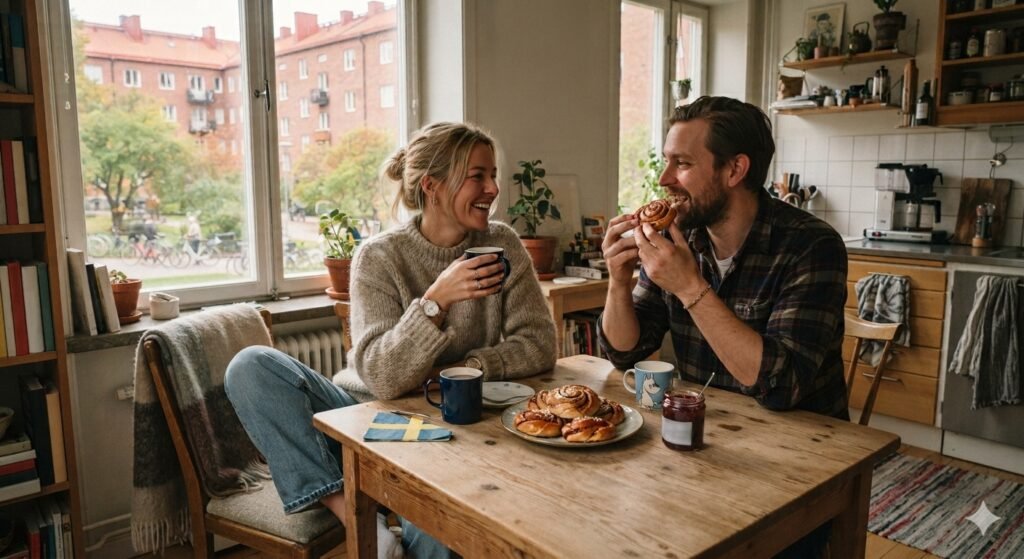
Image Credit : Gemini
There is a particular kind of silence I associate with Sweden.
Not the silence of an empty place.
The silence of a place where people have simply stopped rushing.
I began thinking about Sweden after spending some time imagining an ordinary weekend in Germany.
Germany made me think about rhythm—work, rest, family, food, walking and the quiet distinction between Saturday and Sunday.
But Sweden seems to ask a slightly different question:
What if the weekend is not something we fill, but something we inhabit?
So let us forget Stockholm’s grand attractions for a while.
Forget the Northern Lights.
Forget the photographs of red wooden cottages beside blue lakes.
Instead, let us enter an ordinary Swedish weekend.
A family home.
A Saturday morning.
A walk through the woods.
Coffee and cake.
Perhaps a lake.
Perhaps a sauna.
Perhaps a Sunday spent doing almost nothing.
And somewhere between these ordinary moments, perhaps we will discover something about the Swedish way of life.
Saturday Morning: A Home Waking Slowly
Imagine a Saturday morning in Sweden.
Outside, depending on the season, the world may look completely different.
In summer, the morning light can arrive very early and linger remarkably late.
In winter, daylight may be brief and precious.
This dramatic variation in light is one of the first things that quietly shapes life in Scandinavia.
But inside the house, Saturday morning does not necessarily demand urgency.
There is breakfast.
Bread.
Cheese.
Perhaps yoghurt or porridge.
Coffee.
Children moving around.
Someone opening the curtains.
Someone still sitting in bed with a book.
There is no great ceremony.
And yet there is a feeling that the day belongs to the household.
This is one of the things I find interesting about Swedish life.
The home is not simply a place from which people leave for work.
It is an important part of life itself.
Warmth.
Light.
Wood.
Simple furniture.
A few carefully chosen objects.
Perhaps candles when the outside world is dark.
Perhaps flowers when summer arrives.
The Swedish home seems designed, in many ways, not merely to impress the visitor but to make ordinary life pleasant for the people living inside it.
And that distinction matters.
The Light Outside the Window
If you come from India, Swedish light can feel almost like another language.
We are accustomed to a country where sunlight is abundant for much of the year.
Sweden has a very different relationship with it.
Summer can bring extraordinarily long days, particularly in the northern parts of the country.
Winter brings the opposite experience.
And perhaps this teaches a population something that those of us living in sunnier climates sometimes forget:
Light is precious.
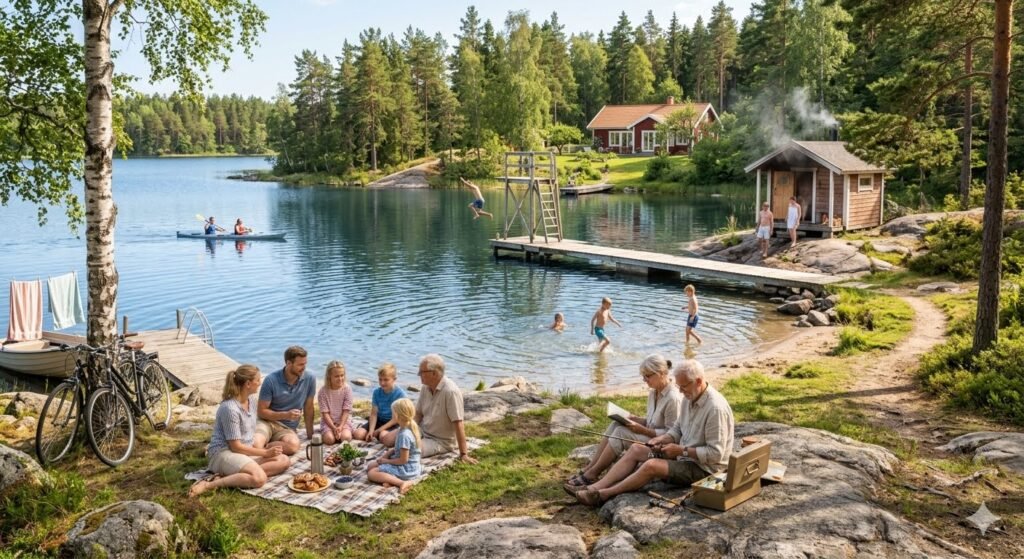
Image credit : Gemini
When summer arrives, people want to be outside.
They sit on balconies.
They eat outdoors.
They travel to the countryside.
They spend time beside lakes.
They walk.
They cycle.
They swim.
They make the most of the light because they know it will not last forever.
This is more than a matter of weather.
It becomes a cultural rhythm.
Saturday: Into the Forest
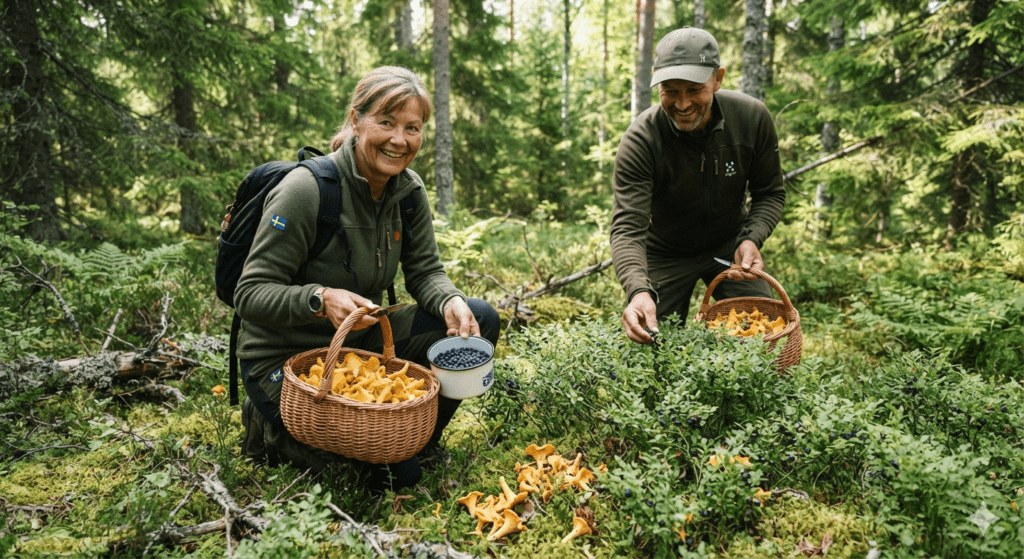
Image Credit : Gemini
After breakfast, perhaps the family goes outside.
There may be a bicycle ride.
A walk.
A trip to the countryside.
Or simply a nearby forest.
And here we meet one of the most important ideas in Swedish life:
friluftsliv.
The word is often translated as “open-air life” or “outdoor life.”
But the idea is larger than simply going for a hike.
It suggests a relationship with nature in which being outdoors is part of ordinary life.
You do not necessarily need to climb a mountain.
You do not need expensive equipment.
You do not have to turn the experience into a sporting achievement.
You can simply walk.
Sit beside a lake.
Pick berries.
Watch birds.
Have a picnic.
Breathe cold air.
Look at trees.
Come home.
Perhaps this is where Sweden feels particularly different from the modern obsession with achievement.
Nature does not have to be conquered.
It can simply be experienced.
A Forest Is Not Far Away
Sweden is a vast country with enormous areas covered by forests and many lakes.
But what interests me is not simply the size of the landscape.
It is the way the landscape enters everyday culture.
Nature is not necessarily a destination reserved for holidays.
It can be part of Saturday afternoon.
A child grows up knowing the forest.
A family may spend time beside a lake.
Someone goes running along a woodland path.
Someone picks mushrooms in autumn.
Someone goes skiing when the snow arrives.
The boundary between “daily life” and “nature” can therefore become remarkably thin.
For an Indian, this feels both familiar and unfamiliar.
We too have strong relationships with landscape.
Villages, farms, rivers, fields, forests and monsoon seasons have shaped Indian life for centuries.
But rapid urbanisation has often pushed nature farther away from everyday life.
Sweden reminds me of the possibility that nature can remain a neighbour rather than becoming a weekend tourist attraction.
The Right to Roam
There is another fascinating Swedish idea connected with this relationship with nature.
It is known as allemansrätten—often described as the “right of public access” or “right to roam.”
In broad terms, it allows people to enjoy much of the countryside even when land is privately owned, provided they respect nature, other people and property.
There are rules and limitations, of course.
But the underlying cultural idea is remarkable.
The countryside is not simply something to look at through a car window.
It is something people are expected to experience responsibly.
Walk.
Explore.
Camp where permitted.
Pick berries or mushrooms where allowed.
Enjoy the landscape.
And leave it as you found it.
There is a lesson hidden inside this.
Freedom and responsibility are often two sides of the same idea.
If people are trusted to enjoy nature, they must also learn how to care for it.
And Then Comes Fika
Eventually, after the walk, something wonderful happens.
People stop.
They sit down.
Coffee appears.
And something sweet accompanies it.
This is fika.
It is often translated simply as “coffee break.”
But that translation does not quite capture it.
Because fika is not really about coffee.
It is about taking a pause.
Talking.
Being together.
Eating something small.
And allowing time to slow down.
Perhaps there is a cinnamon bun.
Perhaps another pastry.
Perhaps coffee or tea.
But the important ingredient is the pause itself.
This is one Swedish tradition that I suspect an Indian could adopt very easily.
We have our own rituals of stopping for tea.
Someone says, “Come, have a cup of tea.”
And suddenly a ten-minute break becomes a conversation.
Tea becomes an excuse for companionship.
Fika seems to perform a similar social function.
It creates a small island of human connection in the middle of an ordinary day.
The Beauty of Not Making Everything Productive
This is perhaps what I find most attractive about fika.
Modern life constantly asks us:
What are you achieving?
What are you producing?
How much have you completed?
How efficiently are you using your time?
Fika seems to answer:
Perhaps this moment does not need to achieve anything.
Perhaps two people can simply sit together.
Perhaps a conversation has value even if it leads nowhere.
Perhaps coffee and cake are enough.
There is something deeply civilised about that.
And perhaps that is why simple rituals survive.
They protect small pieces of humanity from the machinery of efficiency.
Saturday Evening: The Summer Changes Everything
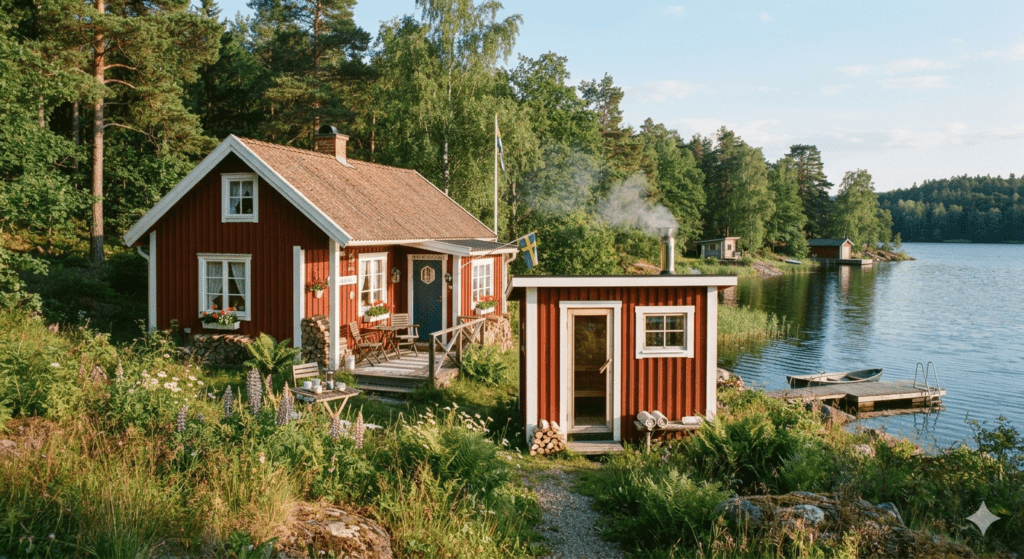
Image Credit : Gemini
If it is summer, Swedish Saturday evening can be almost magical.
The sun may remain visible late into the evening.
People gather outdoors.
A barbecue may be lit.
Friends arrive.
Children play.
Someone brings strawberries.
Someone brings bread.
Someone brings something to drink.
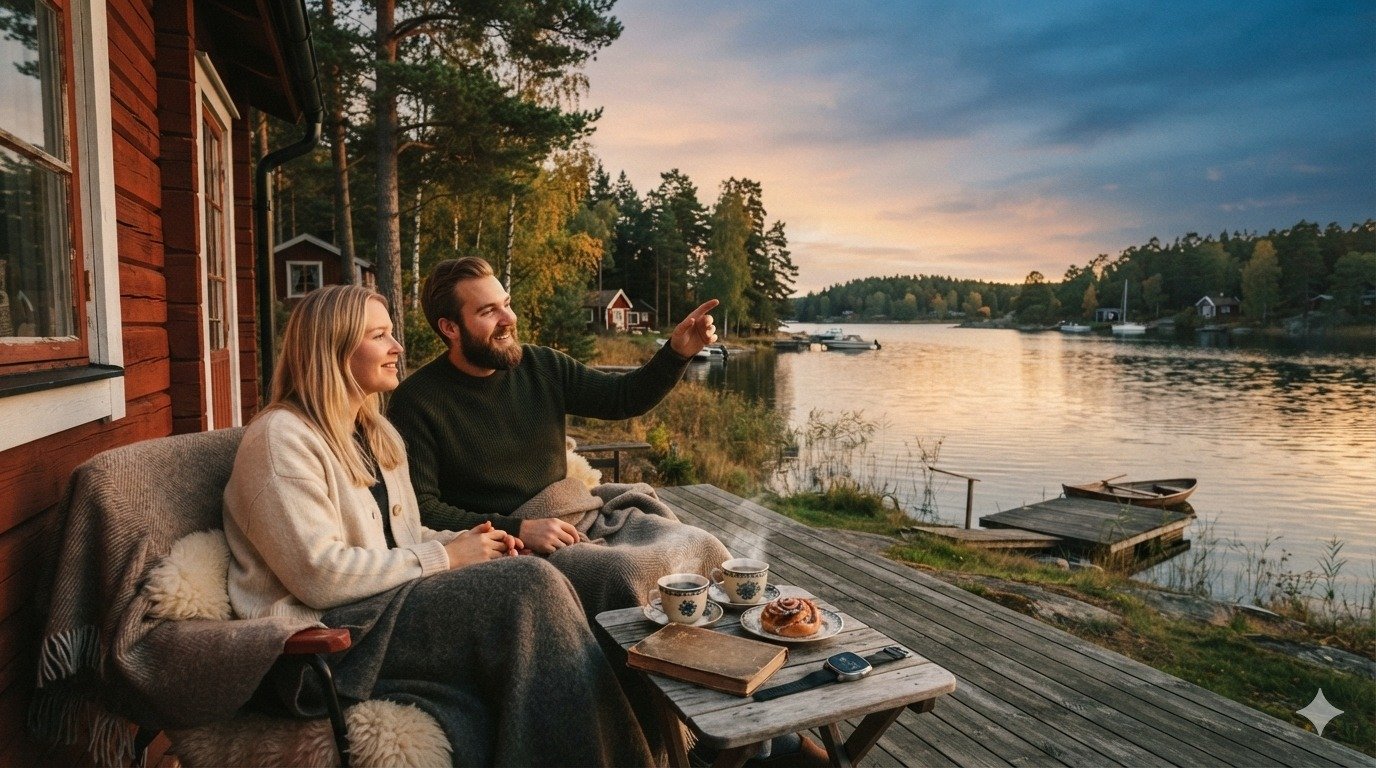
There may be a small summer cottage somewhere beside a lake.
The sommarstuga—summer cottage—is deeply associated with Swedish summer life.
It represents a different pace.
Away from the city.
Closer to water.
Closer to trees.
Closer to family.
Perhaps there is a small wooden house.
A simple table.
A dock reaching into a lake.
A forest behind it.
Nothing luxurious.
And yet perhaps that is precisely the attraction.
A summer cottage does not necessarily give you more things.
It gives you fewer things to worry about.
Winter Tells a Different Story
Of course, Sweden cannot be understood through summer alone.
Winter changes the emotional landscape.
The days become shorter.
Darkness arrives earlier.
Snow may transform the surroundings.
People spend more time indoors.
Homes become even more important.
Warm lamps.
Candles.
Books.
Hot drinks.
Family.
Food.
Conversation.
The outside world may be cold and dark.
The inside world becomes deliberately warm.
This is where the Swedish idea of mys becomes interesting—a sense of cosiness, comfort and pleasant togetherness.
It is not simply interior decoration.
It is an attitude toward creating warmth in difficult seasons.
Perhaps a candle becomes meaningful because the darkness outside makes its light noticeable.
Perhaps a warm room becomes precious because the air outside is freezing.
Perhaps winter teaches people to appreciate small comforts.
And suddenly I understand something.
Climate does not merely determine what we wear.
It can influence what we value.
Sunday Morning: No Need to Hurry
Then Sunday arrives.
Perhaps breakfast is longer.
Perhaps nobody is particularly interested in getting dressed quickly.
There may be reading.
Music.
A walk.
A family meal.
Or simply staying home.
And this is where Sweden’s idea of lagom often comes into the conversation.
The word is difficult to translate perfectly.
“Just enough” comes close.
Not too much.
Not too little.
Enough.
It is often used to describe a preference for balance and moderation.
But I think there is a danger in turning lagom into a national personality test.
Not every Swedish person lives the same way.
No culture can be reduced to one word.
Still, the idea is useful because it gives us a way of thinking about a society that often values balance over excess.
Not the biggest.
Not the loudest.
Not necessarily the fastest.
Just enough.
Sunday Lunch: Together Without Ceremony
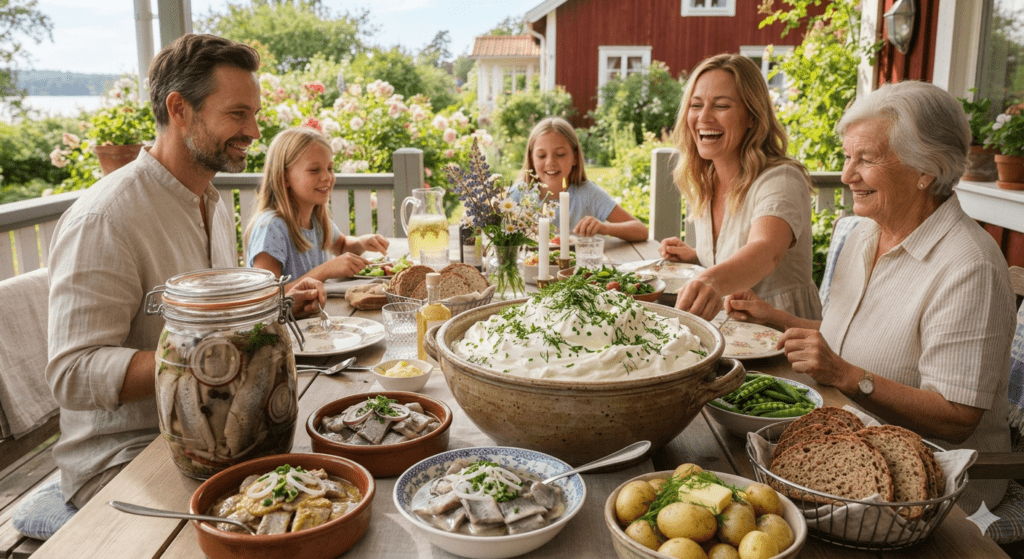
Image Credit : Gemini
Sunday lunch may be simple.
Perhaps fish.
Potatoes.
Vegetables.
Bread.
A seasonal dish.
Swedish cuisine has been shaped by its climate, geography and long relationship with preservation.
Fish has naturally played an important role.
Berries, potatoes, grains and root vegetables have also been part of traditional food culture.
And once again, food tells us about the landscape.
The north.
The forests.
The sea.
The long winters.
The short growing season in many regions.
The need to preserve food.
What appears on the plate is therefore partly a map.
Food is history you can taste.
The Swedish Family Weekend
There is another aspect I find worth noticing.
The Swedish weekend often appears to leave room for children to simply be children.
Outdoor play.
Cycling.
Walking.
Sports.
Nature.
Friends.
Family.
There is certainly pressure and busyness in Swedish society, as there is everywhere.
But the cultural ideal of giving children space, independence and contact with nature remains significant.
Perhaps a child does not need to be entertained every minute.
Perhaps boredom is not a disaster.
Perhaps a forest can be a playground.
Perhaps a lake can be an adventure.
Perhaps childhood needs some empty spaces.
This idea feels especially important in an age when children’s lives everywhere are increasingly filled with screens and scheduled activities.
A Country That Makes Room for Solitude
Sweden also makes me think about another kind of freedom.
The freedom to be alone.
A walk alone.
A quiet evening.
Reading.
Being outdoors without conversation.
Sitting beside water.
There is a difference between loneliness and solitude.
Loneliness is the absence of connection.
Solitude can be the presence of oneself.
Perhaps Sweden’s enormous landscapes make this distinction easier to understand.
There is room.
Room between houses.
Room between towns.
Room in the forest.
Room beside the lake.
And perhaps people learn that being alone for a while does not necessarily mean being lonely.
What an Indian Might Notice
Coming from India, I think I would notice the quiet first.
Then the space.
Then the relationship with nature.
But after a while, I might begin to notice something else.
The warmth.
Because quietness can sometimes be mistaken for coldness.
It should not be.
A family sitting around a table.
Friends meeting for fika.
Someone inviting you to a summer cottage.
Children playing outside.
A meal shared together.
A candle burning on a dark winter evening.
Certainly, these are not signs of a cold society.
Germany and Sweden: Two Different Kinds of Weekend
This is where my little European journey becomes interesting.
Germany and Sweden have much in common.
Both value organisation.
Both have strong relationships with nature.
Both have rich food traditions.
Both have distinctive ideas about family and personal time.
But the emotional atmosphere can feel different.
Germany makes me think of structure.
Sweden makes me think of space.
Germany’s weekend seems to have a rhythm:
Saturday for practical things.
Sunday for rest.
Sweden’s weekend seems to say:
Make some room.
Go outside.
Meet someone.
Have fika.
Let the day unfold.
Neither is necessarily better.
And that is precisely the point.
Europe is not one lifestyle.
It is a collection of different answers to similar human questions.
What the Swedish Weekend Reveals
If we look closely, the Swedish weekend tells us several things.
It tells us that nature can be part of ordinary life.
That darkness can make light more precious.
That coffee can become a social ritual.
That a summer cottage can represent freedom from complexity.
That children can benefit from unstructured outdoor time.
That solitude does not have to be frightening.
That moderation can be an aspiration.
And that a pause does not have to be earned by exhaustion.
Perhaps the deepest lesson is this:
A good life does not necessarily require more.
Sometimes it requires better attention to what we already have.
A forest.
A lake.
A friend.
A cup of coffee.
A warm room.
A family meal.
A long summer evening.
A quiet Sunday.
Perhaps the Weekend Is a Measure of Civilization
We usually measure countries through economic numbers.
GDP.
Income.
Productivity.
Infrastructure.
Technology.
But perhaps there is another measurement.
Ask a simpler question:
What happens to ordinary people when the working week ends?
Do they have time?
Do they have access to nature?
Can families sit together?
Can children play?
Can adults rest?
Can people enjoy their surroundings without spending a great deal of money?
Can a cup of coffee become an occasion?
Can a forest remain part of everyday life?
These questions may not appear in economic statistics.
But they say something about the quality of ordinary life.
And perhaps that is what makes Sweden worth looking at.
Not because Sweden has discovered a perfect way to live.
It hasn’t.
No country has.
But because Swedish culture has preserved certain reminders that modern life desperately needs.
Slow down.
Go outside.
Meet someone.
Take a break.
Enjoy the season.
Leave some empty space.
And Then Monday Comes
Eventually, Sunday evening becomes Monday morning.
The weekend disappears.
School begins.
Work begins.
Trains fill.
Offices wake up.
Phones start ringing.
The ordinary machinery of modern life returns.
But perhaps the forest remains somewhere in the mind.
Perhaps there is still a memory of the lake.
The taste of the cinnamon bun.
The warmth of the summer cottage.
The candle from the winter evening.
The conversation over coffee.
And perhaps that is enough.
Because a weekend does not have to transform your life.
It only needs to return you to it.
An Indian Looking Towards Sweden
Perhaps this is what I take away from an ordinary Swedish weekend.
India has taught me the beauty of abundance.
Sweden makes me notice the beauty of enough.
India teaches us to gather.
Sweden reminds us to leave space.
India’s weekends can overflow with people, food, relatives, celebrations and noise.
Sweden can show us the pleasure of a quiet forest, a small table, a cup of coffee and an unhurried afternoon.
I would not exchange one for the other.
Perhaps I would borrow something from both.
The Indian ability to turn an ordinary meal into a celebration.
The Swedish ability to turn an ordinary pause into a meaningful ritual.
The Indian warmth of togetherness.
The Swedish respect for personal space.
The Indian love of colour and abundance.
The Scandinavian appreciation of light, simplicity and nature.
Maybe that is how travelling through cultures should work.
Not by asking:
Which way is better?
But by asking:
What can I learn from the way another society lives?
The Weekend Belongs to You
And perhaps that is the real story of Sweden.
Not fika.
Not lagom.
Not forests.
Not lakes.
Not even the famous Scandinavian lifestyle.
It is something much simpler.
The idea that life should contain moments that are not designed for achievement.
A walk that leads nowhere.
A coffee that lasts longer than necessary.
A summer evening that refuses to become dark.
A winter room made warm by a small lamp.
A child playing outdoors.
A family sitting together.
A person being quietly alone.
These moments may appear insignificant.
But perhaps a life is made precisely from such insignificant moments.
And perhaps, at the end of a long working week, the most valuable thing a society can give its people is not entertainment.
Not consumption.
Not another achievement.
But time.
Time to breathe.
Time to notice.
Time to talk.
Time to walk.
Time to be.
And somewhere in Sweden, on an ordinary Sunday afternoon, someone may simply be sitting with a cup of coffee, looking out at a quiet landscape.
Nothing remarkable is happening.
And perhaps that is the remarkable thing.
Life is happening.
And the journey continues
Perhaps Sweden leaves us with one final question.
What happens when a European culture learns to live not only with its seasons, but with a different idea of time itself?
Our next journey will take us south.
Away from Sweden’s long summer light and quiet winter interiors, we will enter a country where evenings often seem to belong to the streets, where food is not merely nourishment but conversation, and where a walk after dinner can become a part of the day’s life.
Italy will be our next stop.
There, we will ask another simple question:
Why do Italians still seem to know how to make time for one another?
The answer, perhaps, will tell us something about Italy—and something about ourselves.