The Toy Train That Learned to Speak With Mountains
What the Darjeeling Himalayan Railway teaches us about nature, patience, and human ambition

On a misty morning in Darjeeling, I see this old tea vendor waiting near a small station platform. His kettle breathing thin streams of steam into the cold air. He has likely heard this whistle thousands of times. Before the train appears, its sound arrives first — faint, lingering, almost conversational — echoing through the hills like an old acquaintance announcing itself.
A few tourists adjust scarves and raise cameras. A local schoolboy waits quietly with practiced indifference.
Then, almost shyly, the Darjeeling Himalayan Railway toy train emerges from the mist. Not with the confidence of modern machinery, but with the intimacy of something familiar — as though the mountain has allowed an old friend to pass once again.
For some, it is heritage. For others, nostalgia. But perhaps the true story of Darjeeling’s toy train lies somewhere deeper.
There are some journeys that merely take us from one place to another.
And then there are journeys that slowly rearrange the weather inside us.
The famous toy train of Darjeeling belongs to the second kind.
Long before speed became modern civilization’s obsession, before flights reduced mountains to aerial scenery and highways erased the meaning of distance, a small railway quietly began climbing the Himalayas with unusual humility. It did not rush. It did not dominate. It curved, paused, circled, and listened.
Perhaps that is why the Darjeeling Himalayan Railway still feels alive.
Not because it is efficient.
But because it seems to breathe with the mountain.
In 1999, UNESCO declared the Darjeeling Himalayan Railway a World Heritage Site, praising it as an outstanding example of how an innovative transportation system influenced the socio-economic life of a mountain region. Yet, beneath this formal recognition lies a far more human story — one involving empire, tea, labour, mist, geography, and the strange wisdom mountains quietly impose upon those who enter them.
Before the Train, There Was this Mountain Called Darjeeling Hills
To understand the toy train, one must first understand the mountain that resisted easy access.
Before British intervention in the nineteenth century, Darjeeling was not the celebrated hill station it later became. Thick forests covered ridges. Clouds drifted through silent valleys. The region existed within shifting political influences between Sikkim and Nepal, while indigenous communities like the Lepchas lived closely tied to forests and mountain rhythms.
Then came the British.
Like many colonial powers, they arrived carrying practical needs disguised as vision.
The heat of the plains exhausted British officials stationed in Bengal. They longed for cooler climates — places where bodies and minds could temporarily escape tropical summers. Hill stations soon emerged as climatic sanctuaries, and Darjeeling quickly caught imperial imagination.
But climate alone was not enough.
Darjeeling also possessed strategic importance. Nestled near Nepal, Bhutan, Tibet, and Sikkim, the hills became geopolitically valuable.
Then another discovery transformed everything:
Tea.
The slopes of Darjeeling proved capable of producing extraordinarily delicate tea, shaped by altitude, cool weather, and Himalayan mist. Soon tea estates expanded dramatically.
Yet success revealed an enormous problem.
How does one move tea, people, supplies, and administrative machinery through steep mountains?
Mule tracks and rough roads could not support growing ambition.
And so, in the late nineteenth century, engineers proposed something dating :
A mountain railway.
At first glance, the idea almost sounded absurd.
How could a train climb such gradients?
How could tracks survive unstable hillsides and monsoon rains?
How could machinery negotiate mountains that seemed determined to resist straight lines?
Yet construction began in 1879.
And perhaps this is where the story becomes fascinating.
Because unlike many grand engineering projects of empire, the Darjeeling Himalayan Railway did not overpower geography.
It negotiated with it.
When Mountains Refused Straight Lines
Modern engineering often celebrates conquest.
We tunnel through mountains, straighten rivers, and bridge impossible distances.
But Darjeeling quietly rejected such confidence.
The terrain was too steep for ordinary railway design.
The mountains seemed to say:
You may travel here — but only if you learn patience.
So engineers adapted.
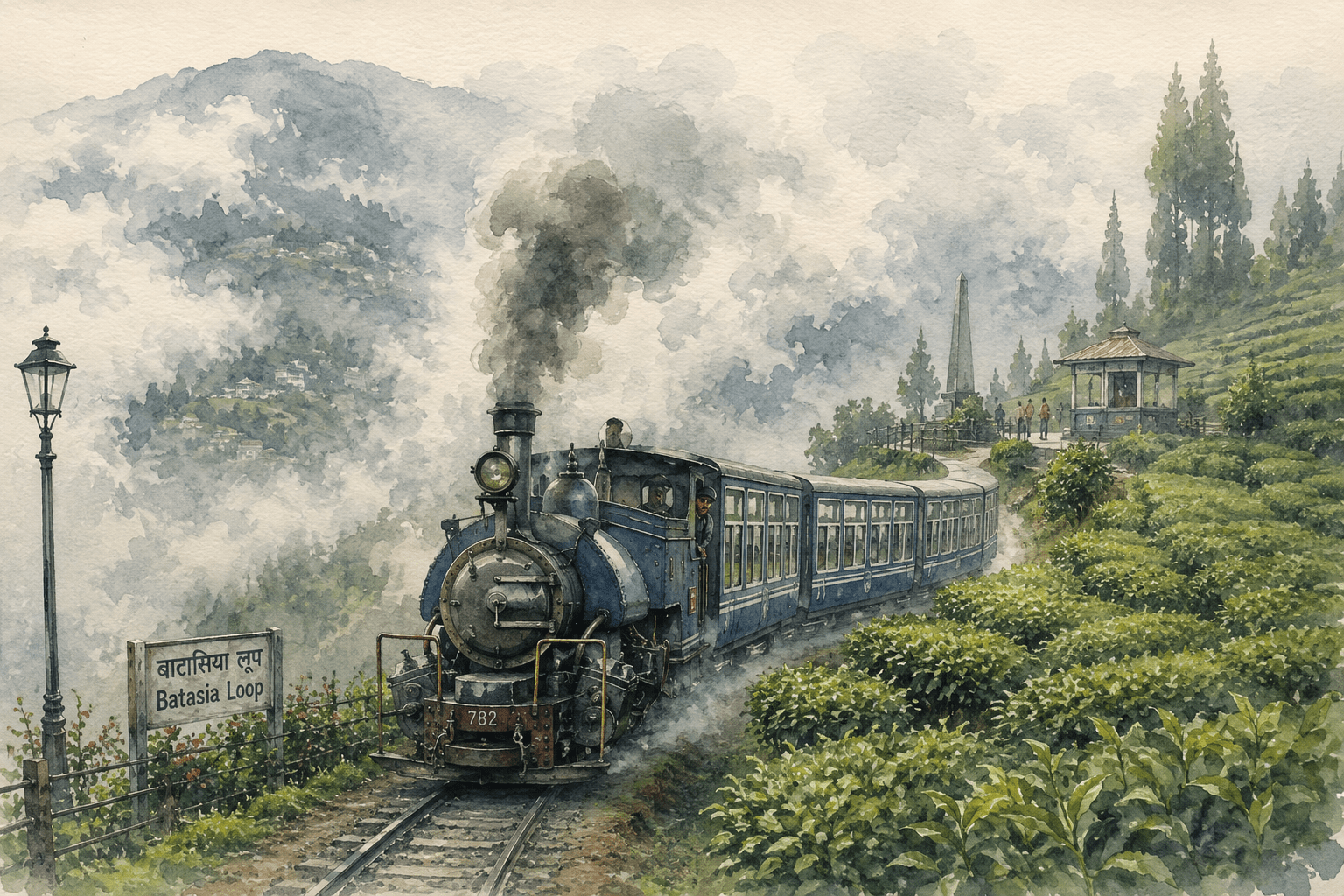
Instead of forcing straight ascents, the railway developed loops, reverses, and sharp curves. It moved not through domination but accommodation.
At places like the famous Batasia Loop, the train circles around itself in order to gain height gradually.
There is something strangely philosophical about this.
The mountain refused urgency.
The railway accepted humility.
Perhaps some destinations cannot be reached directly.
Perhaps even human life occasionally demands circles instead of shortcuts.
Modern people, constantly trained to seek speed, may find this difficult to understand. We want efficiency. Immediate arrival. Faster solutions.
But mountains rarely reward haste.
The toy train teaches something gentler:
Progress need not always be aggressive to be meaningful.
Tea, Labour, and the Quiet Making of a Society
It is tempting to romanticize Darjeeling as nothing more than misty hills and scenic beauty.
But beauty always rests upon labour.
Tea estates expanded rapidly during colonial rule, and with them came migration. Thousands of workers, especially Nepali-speaking communities, arrived in search of livelihood.
Their labour shaped the hills permanently.
The language, food, songs, festivals, and everyday life of modern Darjeeling carry this layered history.
Tea itself demanded patience.
The famous flavour of Darjeeling tea did not emerge from abundance or speed. It emerged from precise climate, careful plucking, altitude, mist, and waiting.
Even tea, it seems, obeyed mountain temperament.
Fast growth rarely produces remarkable tea.
Slow cultivation does.
The railway and tea therefore became unlikely companions.
Neither belonged to hurry.
One moved slowly through mountains.
The other slowly absorbed mountains.
And somewhere between them, communities formed.
Stations became markets.
Markets became settlements.
People built lives beside tracks.
Children grew up hearing whistles echo through clouds.
Tea vendors learned train schedules.
Shopkeepers paused as steam engines passed.
What began as colonial infrastructure gradually became woven into ordinary life.
History often arrives wearing the clothes of power, yet ordinary people quietly transform it into something human.
The Monsoon’s Annual Reminder
If mountains shaped the railway, weather disciplined it.
Particularly the monsoon.
For tourists, rain in Darjeeling may feel romantic — drifting fog, wet leaves, silver skies.
But for railway workers and mountain communities, monsoon often carries anxiety.
Heavy rainfall loosens soil.
Landslides block routes.
Tracks weaken.
Roads collapse.
Suddenly nature reminds everyone of something modern civilization often forgets:
Nothing built by humans is fully permanent.
Every year, the mountain quietly examines the confidence of engineers.
Can your railway survive another season?
Even today, disruptions occur.
And strangely, perhaps this vulnerability gives the toy train much of its emotional power.
Unlike technological systems that project invincibility, the Darjeeling railway feels fragile — dependent upon cooperation with weather rather than victory over it.
Perhaps civilization becomes wiser when it remembers that even infrastructure must remain humble.
Mist: The Railway’s Silent Companion
There are railways that move through landscapes.
And then there are railways that seem made of weather.
The Darjeeling toy train belongs to the latter.
Mist in these hills does not merely decorate scenery.
It behaves like a living presence.
Sometimes it reveals.
Sometimes it hides.
The train appears and disappears within clouds like a memory trying to return.
Visibility narrows.
The world grows quieter.
Tea gardens emerge softly before fading again.
Pine trees arrive like unfinished thoughts.
The whistle travels farther than the train itself.
You hear it before you see it.
Perhaps this is why travellers remember the journey so deeply.
Modern transport often removes transition.
You sleep in one city and wake up somewhere entirely different.
The mind receives no preparation.
But here, the journey unfolds gradually.
The mountain slowly introduces itself.
The weather changes.
The air cools.
The body relaxes.
The mind catches up with geography.
Perhaps some journeys are unforgettable not because of where they take us, but because of what they allow us to feel while arriving.
Why Old Trains Still Move Us
Today, faster roads connect Darjeeling.
Cars are quicker.
Flights shorten distances.
Efficiency has long surpassed romance.
And yet the toy train survives.
Why?
Because it has stopped being merely transport.
It has become memory.
In a world obsessed with acceleration, the train preserves something increasingly rare:
Gradual arrival.
Perhaps humans secretly miss slowness.
We miss transitions.
We miss the emotional preparation that meaningful journeys once demanded.
A child waving from a hillside.
A tea worker glancing briefly at passing steam.
A station wrapped in rain.
A whistle dissolving into fog.
These moments cannot be optimized.
They can only be noticed.
And perhaps that is the hidden wisdom of the Darjeeling Himalayan Railway.
It reminds us that not every meaningful thing in life exists to save time.
Some things exist to deepen it.
The Railway That Chose Conversation Over Conquest
It represents a rare form of progress.
Not progress that crushed mountains.
Not progress that declared victory over nature.
But progress that learned adaptation.
The railway bends because mountains demanded curves.
It slows because gradients required patience.
It pauses because weather insisted on humility.
Some inventions survive because they are useful.
Others survive because they carry memory.
The Darjeeling toy train survives because somewhere between steam, mist, tea gardens, labour, and mountains, it quietly became part of life itself.
Perhaps that is the lesson hidden inside those winding tracks:
The most enduring things are not always the fastest.
Sometimes, what lasts is what learns how to travel beside the world rather than against it.
If you want to dive further in this magical journey, get a connected ride to :