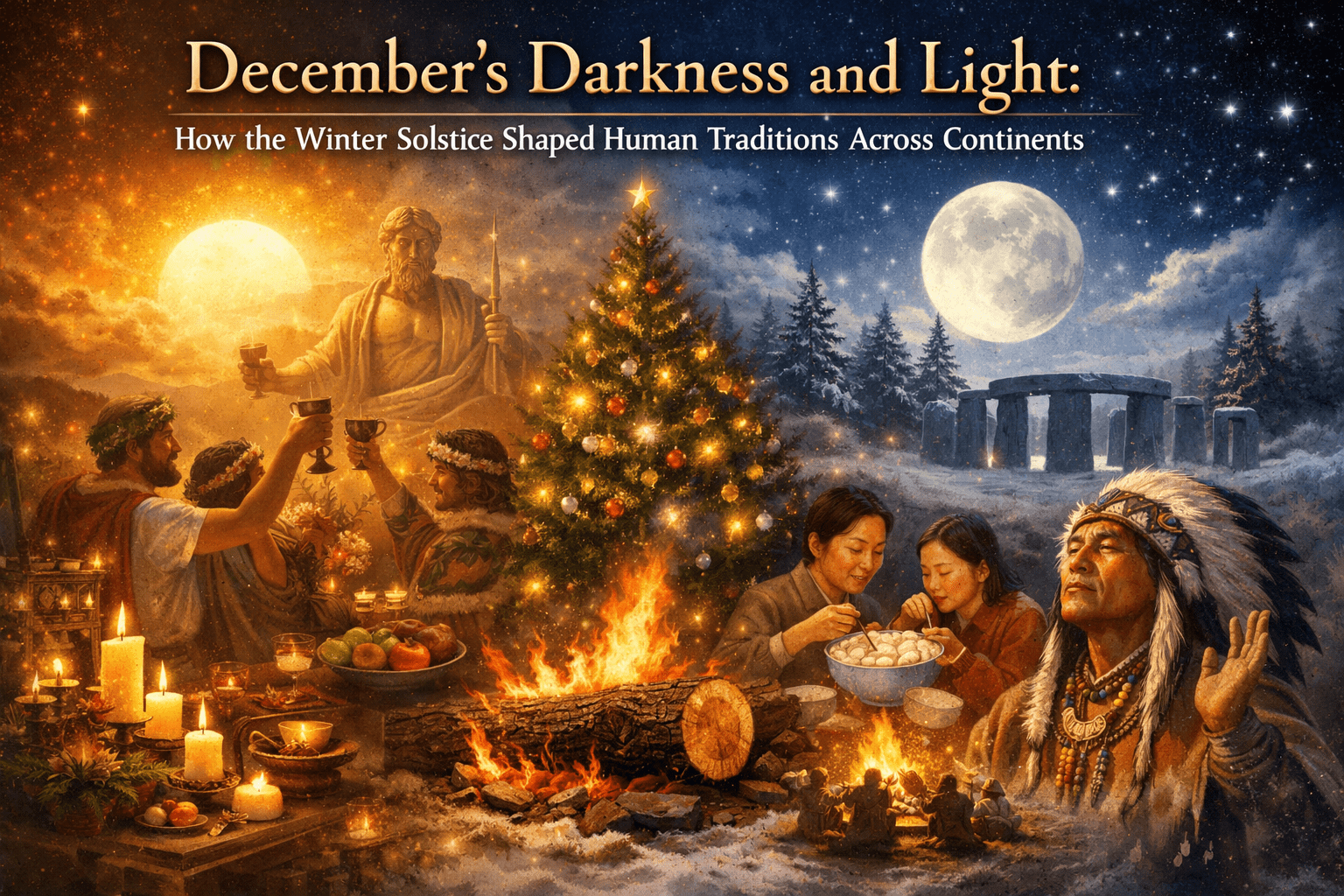
December’s Darkness and Light: How the Winter Solstice Shaped Human Traditions Across Continents
The Month When Sunlight Retreats
In the Northern Hemisphere, December marks a remarkable astronomical turning point. As the Earth tilts farther away from the Sun, daylight shrinks, nights lengthen, and temperatures sink. For people living across Asia, Europe, and North America, this month has historically symbolized transition — a bridge between the fading year and the promise of renewal.
Long before cities glowed with neon lights and screens illuminated our nights, human beings looked at December skies with wonder, anxiety, and anticipation. Would the sun return? Would darkness deepen? The Winter Solstice — occurring around December 21 or 22 each year — became the moment when ancient communities recognized that the longest night had passed and light would once again grow. That cosmic reassurance shaped some of the world’s most enduring festivals, customs, and symbols.
The Science Beneath the Solstice: Earth’s Tilt and Time-honored Awe
The Winter Solstice is not an event created by culture, but a phenomenon dictated by physics. Earth’s axis tilts at approximately 23.5 degrees. In December, the Northern Hemisphere faces away from the Sun, causing fewer daylight hours and colder temperatures. The Sun appears at its lowest point in the sky, casting long shadows and brief days.
Modern astronomy explains all this with ease. But ancient humans lacked satellites, telescopes, and scientific theory. To them, the shrinking sun was a mystery — sometimes even a threat. Observing the heavens was not an intellectual hobby; it was survival. Agriculture, hunting, planning marriages, traveling, storing food — everything depended on knowing what the heavens intended.
It is this anxiety and hope that gave birth to traditions still alive today.
Europe: Where Yule Fires Burned and Saturnalia Rewrote Rules
Saturnalia — Rome’s Festival of Freedom and Light
In ancient Rome, the Winter Solstice coincided with Saturnalia — a week-long celebration honoring Saturn, the god of agriculture. Work paused, social hierarchies flipped, masters served meals to their slaves, and streets filled with music, feasts, and gift exchanges.
The most significant element, however, was light. Oil lamps and candles blazed across homes, defeating the growing darkness outside. If you observe modern European Christmas markets, strings of lights, decorated trees, or holiday gift-giving, Saturnalia’s fingerprints are unmistakable.
Yule — Waiting for the Sun in the North
Farther north, the Germanic and Nordic peoples celebrated Yule. They burned colossal logs — Yule logs — which symbolized the returning sun. Every spark promised a future harvest. Evergreen trees, symbols of life that defied frost, became sacred guardians of hope.
Today’s Christmas tree tradition echoes these ancient beliefs. What began as a spiritual reassurance against endless winter evolved into a universal symbol of festivity.
Asia: The Dongzhi Festival and the Philosophy of Balance
While Europe responded to winter with fire and revelry, Asia approached the solstice through philosophy and family.
Dongzhi — When Yin Gives Way to Yang
Celebrated in China and parts of East Asia, Dongzhi means “arrival of winter.” It is steeped in the yin-yang principle: when darkness reaches its peak, light quietly begins its return. And so, Dongzhi is not a festival of fear, but of gratitude and harmony.
Families gather for special meals, especially tangyuan — glutinous rice balls whose round shape signifies completeness. Eating them represents reunion, hope, and the sweetness of life returning.
Dongzhi teaches an idea often forgotten in the digital age: winter is not merely cold and barren. It is a pause, a teacher, a moment for reflection.
This cultural wisdom resonates beautifully with readers worldwide — especially those seeking meaning beyond commercial holidays.
North America: Indigenous Solstice Rituals and Respect for Nature
Long before colonial traditions arrived, many Indigenous communities in North America honored the Winter Solstice with ceremonies centered around fire, storytelling, and gratitude.
To them, the sun was not merely a celestial body. It was kin — a companion that required acknowledgment. Fires were lit to encourage its return, drums echoed across settlements, and elders recited origin stories under the longest night.
Even today, solstice gatherings continue among various Native American groups, blending ancestral practices with contemporary spiritual expression. Each flame lit in December carries thousands of years of memory.
Light vs. Darkness: Universal Symbols Across Time
No matter the continent, ancient humans shared similar anxieties — and arrived at strikingly similar symbols.
| Element | Meaning Across Cultures |
|---|---|
| Fire / Lights | Protection from darkness, hope, rebirth |
| Evergreen Trees | Life that defies winter |
| Feasts | Strengthening community bonds |
| Gifts | Reciprocity, goodwill, renewal |
| Gathering | Emotional and psychological resilience |
These elements travel into modern life effortlessly. The bonfires of Yule resemble backyard winter gatherings. Dongzhi’s family meals mirror Christmas dinners. Gift exchanges once meant honoring gods; now they express affection.
Our modern rituals are ancient answers in new clothes.
December Today: Urban Skylines, Old Instincts
We may live in heated rooms, order groceries online, and rely on digital calendars, but our instincts remain old. When December arrives:
- Cities illuminate their streets with lights.
- Families return home after long months apart.
- People cook comforting meals.
- Strangers exchange greetings.
- Homes sparkle with candles, lanterns, and trees.
We think we are celebrating holidays. In truth, we are reenacting humanity’s oldest defense against despair: togetherness.
Why the Winter Solstice Still Matters
December forces us to pause. Nature slows. Trees shed leaves. Fields sleep. Birds migrate. Snow softens sound.
Ancient humans read these signs as messages — and perhaps they were right.
The solstice teaches us:
- Darkness is not permanent.
- Light returns gradually, not suddenly.
- Renewal is a natural law.
- Stillness has purpose.
Modern life may be hurried, but December invites us to breathe differently. If there is a month that listens to human hearts, it is this one.
Conclusion: A Season that Holds the World’s Breath
December is not just a month. It is a threshold — a quiet hinge on which the year turns. The Winter Solstice is the heartbeat beneath its quiet chill: invisible yet powerful, ancient yet present.
When we light candles, gather with family, or decorate trees, we are performing memories older than nations. We echo voices of ancestors who once asked the same questions we do:
Will the light return?
Will tomorrow be brighter?
December answers gently — yes.