First Accept The Way You Are: Finding Your Life’s Reference Points
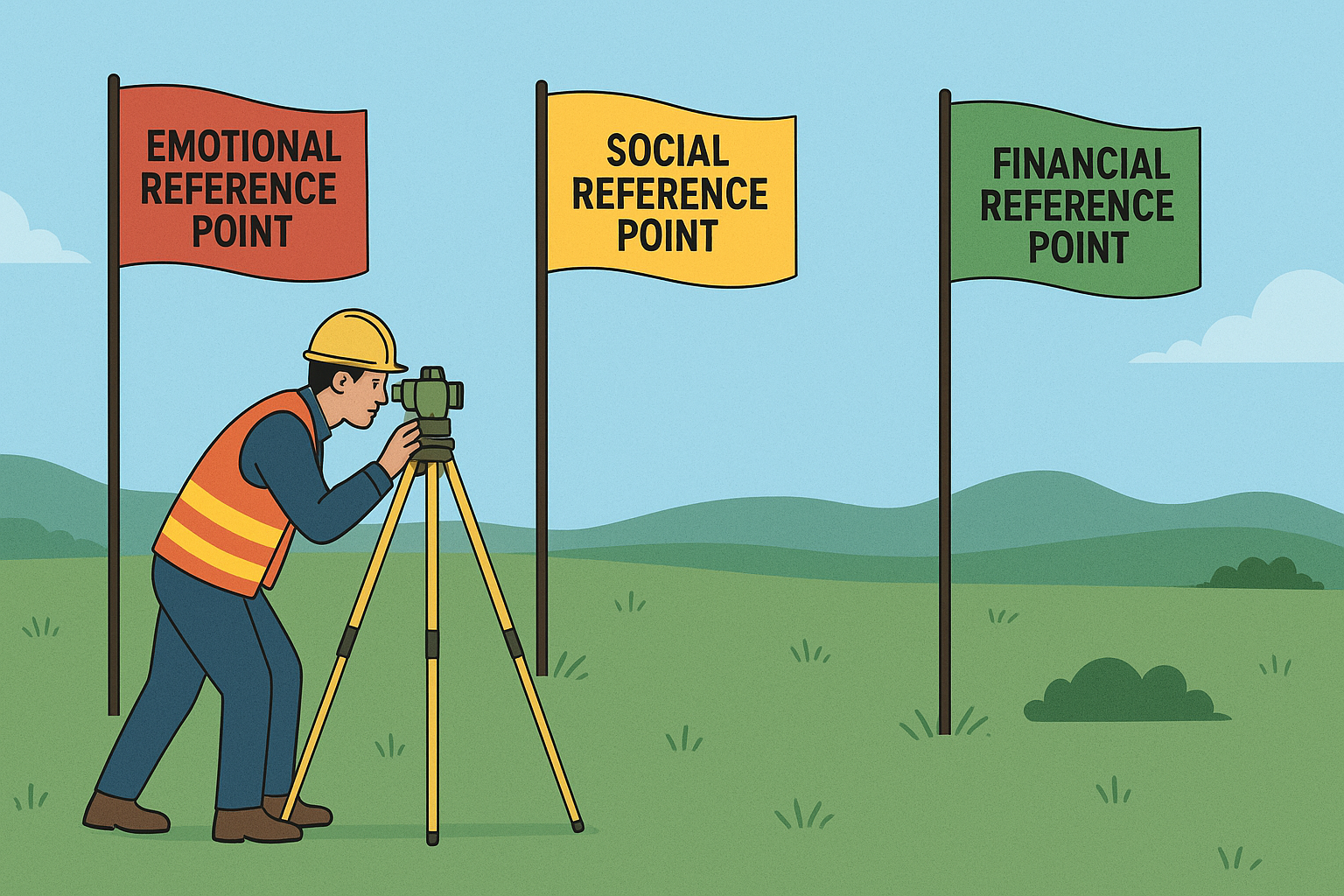
Why I said this -“First Accept the Way You are” . Answer lies in one sentence – it lets you know your reference points in life in terms of your emotional, financial and social positioning.
Didn’t get that ? No worry. Come along with me.
For last few months, my native state of Bihar in India is undergoing a mega land survey exercise in its villages. For many of our visitors to this website, thelifespeaks.com, who live continents apart geographically, I would like to brief them that the lands in the state of Bihar in India are very fertile and home to an unimaginably high population density. Other employment opportunity are meagre. Now, just imagine the compounding effect this dangerous combination has, on our socio economic issues! Thus in order to douse the land related disputes at its source, the land survey program was started by the state government here.
For the first time in years, the otherwise quiet fields were buzzing with activity. Farmers gathered around, curious and anxious, as the team started marking tiny flags in the soil.
What caught my attention was not just their precision, but the method. Before drawing any boundary lines, they first fixed reference points – small iron pegs were hammered deep in to the earth. Some primary reference points had already been fixed since time immemorial, like -some well in the village, or a stone embedded at tri junctions or village cross roads. Actually the new iron pegs and tiny flags were the secondary reference points taken in reference to these age old primary ones.
From those fixed coordinates, every boundary, every inch of land, every map of line would be drawn. If those reference points were misplaced, the entire map would go wrong. The farmer’s land could be shown smaller than it was, or someone else’s field might seem larger. Everything depended on where the reference points were set.
And as I stood watching them, a quiet thought took root in my mind — aren’t our lives much the same?
As the old Greek saying goes, “Know thyself.” Without that, no map of life can ever be drawn straight.
The Map of Self
In life, many of us start running before knowing the direction. We look at others — their success, their happiness, their possessions — and we try to redraw our map using their coordinates.
But imagine a surveyor who ignores his own fixed points and copies his neighbor’s. The result would be a disaster — misplaced lines, wrong measurements, endless disputes.
Life, too, gets chaotic when we lose our own coordinates.
A young man compares his first job to his friend’s high-paying tech role and feels defeated. A woman feels behind because her school friend now lives abroad. A farmer feels inferior because his neighbor bought a tractor while he still uses oxen.
But these comparisons only distort the map of the self.
Because we are all standing on different soil, under different skies.
As an American proverb gently reminds us, “Bloom where you are planted.”
To accept the way you are doesn’t mean to give up ambition — it means to understand your ground realities and begin from there, not from where someone else stands.
Emotional Reference Point: Knowing Your Inner Weather
Each person has a different emotional climate. Some are born in the sunlight of optimism, others grow up under clouds of struggle and insecurity. To accept your emotional reference point means to first acknowledge your current state honestly.
If you feel anxious often, don’t shame yourself into “being positive.”
If you are tired, don’t pretend to be tireless.
Recognizing your emotional weather is the first step to planning your inner journey.
When a pilot flies, the flight path depends on the current weather, not on yesterday’s forecast. Similarly, the emotional map of your life must start from the truth of today — how you really feel.
A Chinese proverb whispers, “When the root is deep, there is no reason to fear the wind.”
Once you accept your inner truth, no external storm can uproot you.
Financial Reference Point: Knowing the Real Starting Line
Money is another powerful coordinate of life — though not the only one. Yet, we often start our plans without knowing our actual financial reference point.
We dream of big houses, expensive cars, and world tours, without checking where our financial ground actually lies.
When you accept your financial truth, you find clarity. You may realize you can’t yet afford the car you want — but you can start a savings plan today. You may not have wealth, but you might have skills that can become wealth tomorrow.
What matters is honesty — not pretending to be rich or poor, but knowing exactly where you stand.
As the Persian poet Rumi wrote, “He who knows his own weakness is the strongest of all men.”
Acceptance of one’s limitation is not defeat — it’s wisdom.
Even great entrepreneurs began from a clear reference point. Dhirubhai Ambani started as a petrol pump attendant in Yemen. Steve Jobs started in his garage. They didn’t fake their position in life; they used it as their launchpad.
Social Reference Point: Understanding the Ground Around You
Society, too, plays a defining role in your life’s map. The kind of family you belong to, your network, your community — all these form the boundaries within which you move.
Some people inherit wide-open spaces — connections, privilege, support. Others begin in smaller, rougher terrains.
But remember: even the narrowest path can lead to open fields, if you walk it with awareness and patience.
A Native American saying goes, “You can’t know where you’re going until you know where you’ve been.”
Accepting your social reference point doesn’t mean being bound by it. It means understanding your surroundings so you can choose your route wisely.
You might have fewer social opportunities — but perhaps more freedom to experiment. You might have limited support — but a stronger will to stand alone.
The Art of Starting from Where You Are
When I watched the surveyor mark the first peg into the soil, he didn’t look around nervously. He didn’t say, “Let me start from where the other team started yesterday.” He simply trusted his tools, his training, and his point of reference.
From there, the map grew — accurate, beautiful, meaningful.
In life, your tools are self-awareness, honesty, and acceptance. Once you fix your reference points truthfully, your path will begin to draw itself.
As the Japanese say, “Be not afraid of growing slowly, be afraid only of standing still.”
Progress is not a race — it is alignment with your truth.
You will no longer compare your journey with others’. You will no longer feel behind or ahead. You will just be on your path, moving with confidence, because your direction is anchored in truth.
Finally
The land survey in my village is under progress. The flags still flutter on the fields, marking boundaries that have always existed but were never clearly drawn.
It made me realize that clarity is not about creating something new — it’s about recognizing what already is.
So, take a pause today. Look around your life and ask yourself:
- Where do I stand emotionally?
- What are my real financial limits and strengths?
- How does my social circle shape my opportunities?
Once you answer these with honesty, your personal map will begin to emerge — authentic, grounded, and yours alone.
Because, as the Buddhist proverb says, “The lotus blooms in muddy water.”
Your best version will rise — not from ideal conditions, but from truthful self-acceptance.